The short answer
In Western churches that keep Lent, the season starts on Ash Wednesday, and in 2026 that is Wednesday, February 18. Where it ends is the part that trips people up. The Catholic Church's own rules end Lent before the Evening Mass of the Lord's Supper on Holy Thursday, which is April 2 in 2026. Many Anglican, Lutheran, Methodist and Reformed churches run it through Holy Saturday, April 4. Easter Sunday is April 5, and none of the sources checked for this page counts Lent as reaching that far.
Eastern churches answer differently again. Eastern Orthodox, Eastern Catholic and Oriental Orthodox churches keep Great Lent as a continuous forty days that starts on Clean Monday and ends on Lazarus Saturday, before Holy Week begins. That is a separate season with its own start, not a variation of the Western one.
Lent dates from 2026 to 2031
Each line gives Ash Wednesday, Holy Thursday, Holy Saturday and Easter Sunday for Western churches.
2026: Ash Wednesday February 18, Holy Thursday April 2, Holy Saturday April 4, Easter April 5.
2027: Ash Wednesday February 10, Holy Thursday March 25, Holy Saturday March 27, Easter March 28.
2028: Ash Wednesday March 1, Holy Thursday April 13, Holy Saturday April 15, Easter April 16.
2029: Ash Wednesday February 14, Holy Thursday March 29, Holy Saturday March 31, Easter April 1.
2030: Ash Wednesday March 6, Holy Thursday April 18, Holy Saturday April 20, Easter April 21.
2031: Ash Wednesday February 26, Holy Thursday April 10, Holy Saturday April 12, Easter April 13.
The 2026 row matches the USCCB calendar, which lists Ash Wednesday on February 18, Easter on April 5 and the Evening Mass of the Lord's Supper on Thursday, April 2. In every year the gap between Ash Wednesday and Easter is 46 days, so only the calendar dates move, not the length of the season.
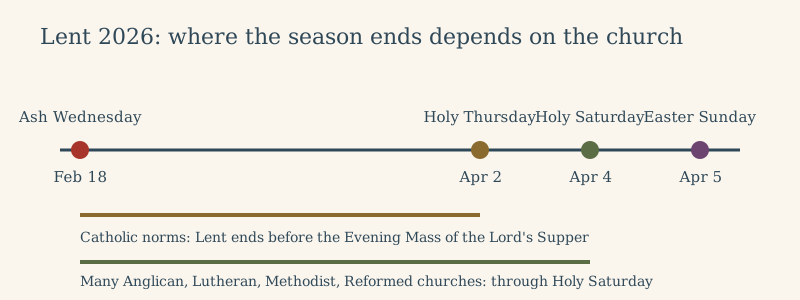
Why the end of Lent has two answers
The Universal Norms on the Liturgical Year, the document behind the Roman Catholic calendar, put it in section 28: the forty days of Lent run from Ash Wednesday up to, but not including, the Mass of the Lord's Supper. That Mass is held on the evening of Holy Thursday and opens the three-day Easter Triduum. On the Catholic calendar, Lent is therefore over by Thursday evening, and Good Friday and Holy Saturday belong to the Triduum.
Wikipedia's article on Ash Wednesday says Lent ends on Holy Saturday in the Moravian, Lutheran, Anglican, Methodist and Reformed churches, and its article on Lent says that depending on denomination and local custom Lent concludes either on the evening of Holy Thursday or at sundown on Holy Saturday. It adds that fasting observances are kept until the evening of Holy Saturday in either case. So the two answers are less far apart than they look. The disagreement is about what to call the last two days, and the fast is usually the same.
Neither the Catholic norms nor the Protestant practice described above carries Lent past Holy Saturday. Easter starts a separate season.
Forty days, forty-six days
The number in the name and the number on the calendar do not match. From Ash Wednesday to Holy Saturday inclusive is 46 days, and six of them are Sundays. Wikipedia's Ash Wednesday article says Lent is forty days long not including Sundays, and its Lent article explains that Sundays, being the Lord's Day, are not regarded as fasting days. That is how 46 days on the calendar become the forty of the name.
That count is a Holy Saturday count. On the Catholic calendar the season itself stops on Thursday evening, while Wikipedia's Lent article says fasting observances continue until Saturday evening either way. So searches for "how long is Lent" can return answers that differ by a day or two without any of them being wrong.
How the start date is worked out
Ash Wednesday is always 46 days before Easter, and Easter is set by the church's rule: the Sunday after the first full moon on or after the March equinox, with the equinox fixed at March 21 for this purpose. Because that rule tracks the moon, Ash Wednesday can land anywhere from early February to early March. This page does not compute Easter itself. The dates above are transcribed from published calendars and checked against each other, the same approach the site takes for other moon-driven dates such as the Corn Moon.
For another observance where the date is set by an organization each year and cannot be derived by a formula, see Banned Books Week. For a calendar question about closures rather than dates, Columbus Day: What's Open covers which offices and banks close.
Eastern churches: Great Lent
In Eastern Orthodox, Eastern Catholic, Eastern Lutheran and Oriental Orthodox practice, Great Lent starts on Clean Monday, which falls on a Monday rather than a Wednesday, and ends on Lazarus Saturday, before Holy Week. Wikipedia describes it as observed continuously, without interruption, for forty days. Holy Week is then a separate period of its own.
Orthodox churches follow their own Easter date. In 2026 it falls on April 12, a week after the Western Easter on April 5, according to Wikipedia's list of dates for Easter, so Great Lent and Western Lent start on different days. Anyone planning around a specific congregation should use that congregation's own calendar.