What Kwanzaa is
Kwanzaa is a seven-day African American and Pan-African cultural holiday. It begins on December 26 and ends on January 1, the same dates every year. Dr. Maulana Karenga created it in 1966 with the Organization Us, the Black cultural organization he led in Los Angeles, and the holiday is organized around seven communitarian values called the Nguzo Saba, one for each of its days.
Kwanzaa does not appear on the federal employee holiday list established by 5 U.S.C. § 6103(a). The name comes from the Swahili phrase matunda ya kwanza, which means first fruits, and the holiday is modeled on African first-fruits harvest celebrations rather than on any single national tradition.
Is Kwanzaa a religion?
No. The Official Kwanzaa Website, which publishes Karenga's writing on the holiday, draws the line in those words: "Kwanzaa is a cultural choice as distinct from a religious one." The same page calls it not a religious holiday but a cultural one with what it describes as an inherent spiritual quality. The site separates spirituality, meaning an appreciation of the transcendent, from religion, which it ties to formal structures and doctrines.
That source also says Africans of all faiths observe Kwanzaa and names Muslims, Christians, Black Hebrews, Jews, Buddhists, Bahai and Hindus among them. It describes the holiday as a shared cultural ground and states that it is not offered as a substitute for anyone's faith.
So Kwanzaa carries no religion of its own, the way Christmas carries Christianity. Observances that do sit on a church calendar, such as Lent, move from year to year with it. Kwanzaa does not.
Seven days, one principle each
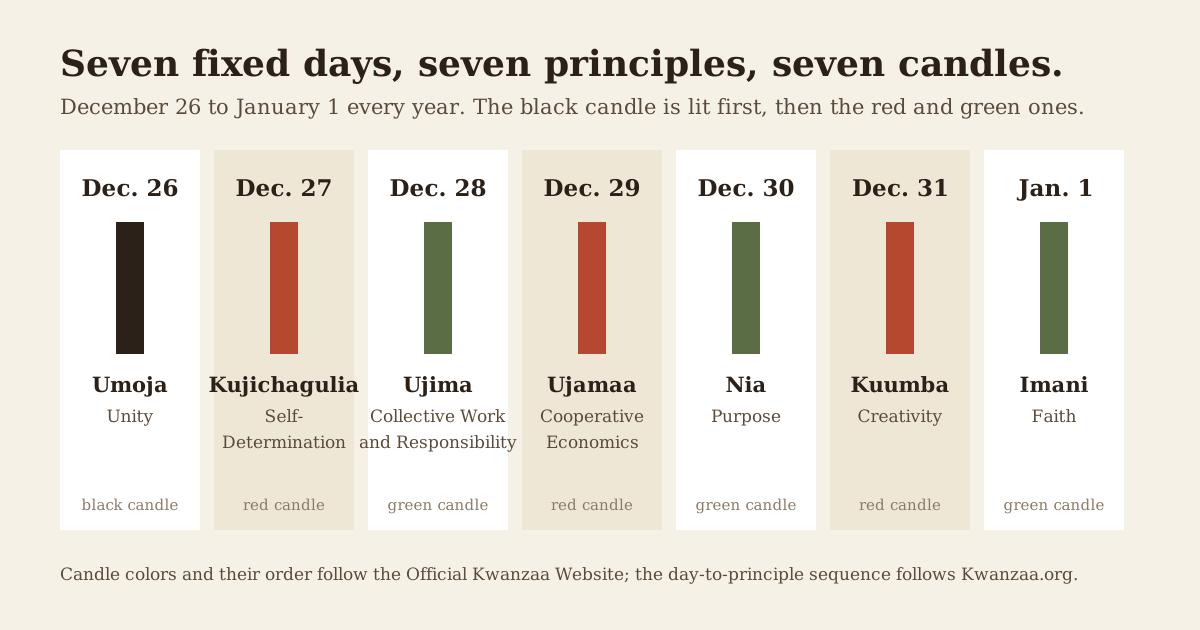
Each day carries one principle. December 26 opens with Umoja (Unity). The sequence then runs Kujichagulia (Self-Determination) on December 27, Ujima (Collective Work and Responsibility) on December 28, Ujamaa (Cooperative Economics) on December 29, Nia (Purpose) on December 30, Kuumba (Creativity) on December 31, and Imani (Faith) on January 1, the closing day.
The candle holder is the kinara, and it holds seven candles, the mishumaa saba. One is black, three are red and three are green. The black candle stands in the center and is lit first, on December 26. The red candles stand to its left and the green ones to its right, and they are lit on the nights that follow. The founder's site gives the colors their meanings: black for the people, red for their struggle, and green for the future that comes out of that struggle.
The dates are fixed by rule, so the span always opens on December 26 and closes on January 1. The fixed December 26–January 1 dates resemble other observances with set calendar dates, including Red Ribbon Week (October 23–31) and National Hispanic Heritage Month (September 15–October 15). Each keeps its own date rule from year to year.
The founder's site gives two reasons the holiday runs seven days. One is authenticity: it is modeled on African first-fruits celebrations, and the Umkhosi of Zululand lasts seven days. The other is the principles, since seven values needed seven days to carry them.
Who started it, and when
Kwanzaa was created in 1966 by Dr. Maulana Karenga, a professor of Africana Studies who chaired that department at California State University, Long Beach, together with the Organization Us. The holiday came out of the Black Freedom Movement of the 1960s, and Karenga has described it as an act of cultural recovery and reconstruction.
The origin account published by Kwanzaa.org, which draws on Karenga's 2008 book Kwanzaa: A Celebration of Family, Community and Culture, dates the idea to December 1965, when members of Us were arguing over which December holidays to keep and a ten-year-old named Kinamo Damu asked what Africans did. A research committee led by George Subira then spent several months in Los Angeles public libraries studying African harvest celebrations, and Karenga chose the name. The first celebration is placed in Los Angeles in the 1966 holiday season.
The spelling has its own history. Kwanzaa comes from matunda ya kwanza, first fruits, and the founder's site says the extra a was added in the early days of Us: seven children each wanted to represent a letter, kwanza has only six, so a seventh letter was added to the word.
What sits on the mat
The founder's site lists seven primary symbols and two supplemental ones. The primary set is Mazao (the crops), Mkeka (the mat), Kinara (the candle holder), Muhindi (the corn), Kikombe cha Umoja (the unity cup), Mishumaa Saba (the seven candles) and Zawadi (the gifts). The supplemental symbols are the Bendera, a flag in black, red and green, and a poster of the seven principles.
Gifts, or zawadi, go mainly to children. The founder's site is specific about what they must contain: every gift should include a book and a heritage symbol, the book to emphasize the African tradition of learning and the symbol to reinforce a commitment to history. Community Kwanzaa guides add that presents can be handed over one a day or on January 1, and that handmade or modest ones suit the holiday better than expensive ones.
The greeting, and the last day
Kwanzaa has a greeting of its own, in Swahili: Habari gani? The answer is the principle of that day, so a household replies Umoja on December 26 and Imani on January 1. The founder's site explains why Swahili was chosen, describing it as a Pan-African language picked to point at the whole of Africa instead of one ethnic or national tradition.
January 1 carries a name of its own: the Day of Meditation, or Siku ya Taamuli. The founder's site describes it as a day of sober assessment and self-reflection, and lists the questions it is meant to prompt: who am I, am I really who I say I am, and am I all I ought to be. It traces the practice to the Akan first-fruits harvest, where J. B. Danquah recorded a day set aside for quiet reflection and for keeping a calm and humble attitude toward oneself and one's neighbors.
Nobody has a reliable count
There is no official count. A 2009 estimate put the number of Americans celebrating Kwanzaa at between 500,000 and 2,000,000. That figure comes from Keith Mayes, a University of Minnesota historian of the holiday, who gave it to the Associated Press, and he has also said exact figures are difficult to establish and that the same problem applies to the other main African American holidays.
Surveys that do state a method have landed elsewhere. A Public Policy Polling survey in December 2012 put Kwanzaa at 4 percent of respondents, against 87 percent for Christmas and 3 percent for Hanukkah. That poll asked 500 registered voters which holiday was their primary one; it recorded Kwanzaa at 4 percent. The question and sample differ from Mayes’s estimate of people celebrating, so the two figures do not measure the same thing and cannot be compared as population totals.