Canadian Thanksgiving 2026 at a glance
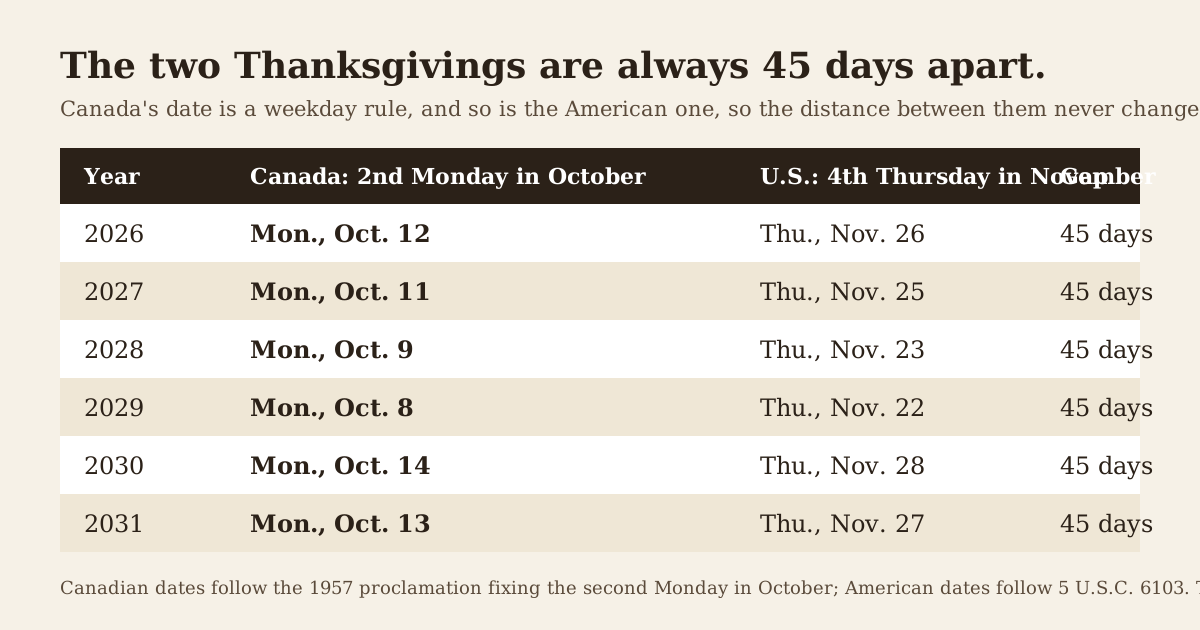
Canadian Thanksgiving 2026 falls on Monday, October 12. The American Thanksgiving comes on Thursday, November 26, which puts the two 45 days apart. That distance is not a quirk of this year's calendar. Both holidays are pinned to a weekday instead of a date, Canada to the second Monday in October and the United States to the fourth Thursday in November, and the arithmetic between the two rules gives 45 days in every year from 2026 through 2031, and in every year from 2020 to 2060 as well.
October 12, 2026 is also the date of Columbus Day, which the United States sets for the same second Monday in October, so the two North American holidays share a Monday this year. October's other observances are gathered in National Days in October.
The rule, and the document that set it
Canada's date does not come from an act of Parliament, though several reference works say Parliament set it. It comes from a proclamation that Governor General Vincent Massey issued at Government House in Ottawa on January 31, 1957, and the document says outright that the point was to stop settling the date year by year. The Manitoba Historical Society transcribes the operative sentence, which appoints "the second Monday in October in each and every year as a day of general thanksgiving" and then fixes it "in the year of Our Lord one thousand nine hundred and fifty-seven and each year thereafter".
Two things about that document matter more than they look. It is a proclamation rather than a statute, which is why a search of the federal statute book for a Thanksgiving statute comes up empty. And it settled the date, not the holiday. Thanksgivings had been proclaimed in Canada since 1859; what had never happened was a standing rule for when.
Why is Thanksgiving in Canada in October?
The question has a paper trail, and it runs well before 1957. For most of the nineteenth century the day floated. A harvest thanksgiving proclaimed for November 3, 1859 is treated as the beginning of the holiday in Canada. An 1879 proclamation set November 6 as the first annual observance. By 1898 the federal proclamation had drifted to Thursday, November 24, the last Thursday of the month, which put Canada on the same date the United States was using.
That alignment did not survive. The Manitoba Historical Society's history of the holiday, drawing on Anne Foster's book on Canadian high days and holidays, records the objection in a single line: it was found to be too late and too near Christmas. In 1899 the observance moved to October. It went back to November for a decade from 1921, for a reason that had nothing to do with the harvest.
So the documented answer to why the date sits in October is that November lost on proximity to Christmas and October won as the harvest month that was still clear of December. The earlier-harvest explanation that most pages give describes why October suits the country, and it is a fair reading of the outcome, but the 1957 proclamation states no reason at all, which makes the harvest argument an inference from the result.
The years it spent in November anyway
October was not the end of the moving. After the First World War the day was proclaimed for the Monday of the week containing November 11, and an act of 1921 merged Thanksgiving with Armistice Day outright. The two holidays stayed on the same date for the next decade. The Armistice Day Act was amended in 1931, the November observance was renamed Remembrance Day, and Thanksgiving went back to October. The 1975 Manitoba Pageant history names only 1921 and 1922 for the shared dates; the federal account and the Canadian War Museum both run the arrangement through to 1931, which is the reading followed here. Remembrance Sunday is the modern British cousin of that November observance, kept on its own rule.
From September 12, 1931 the day was proclaimed for the second Monday of October for 26 consecutive years, with 1935 the single exception, when the proclamation was revoked because an election fell on the date. Then the 1957 proclamation removed the need to proclaim it at all. Veterans Day covers the November 11 observance on the American side, which follows a fixed date, not a weekday.
Is Thanksgiving a statutory holiday in Canada?
Canada's federal statute book is oddly quiet about Thanksgiving. The Holidays Act, R.S.C. 1985, c. H-5, names three days: Canada Day, Remembrance Day and Victoria Day. Thanksgiving is not one of them. The Canada Labour Code, R.S.C. 1985, c. L-2, s. 166, does list it, inside a definition of "general holiday" that runs through New Year's Day, Good Friday, Victoria Day, Canada Day, Labour Day, the National Day for Truth and Reconciliation, Thanksgiving Day, Remembrance Day, Christmas Day and Boxing Day. That definition reaches federally regulated workplaces, which is to say banks, airlines, railways and telecoms.
For everyone else the answer depends on where they work. Nine of the thirteen provinces and territories give workers a paid statutory holiday that day. The four Atlantic provinces are the exception, and each handles it its own way, usually as a retail closing day rather than a paid day off. Newfoundland and Labrador's Labour Standards Act is explicit about its own list: section 14(1) defines a public holiday as New Year's Day, Good Friday, Remembrance Day, Memorial Day, Labour Day and Christmas Day, with a catch-all for days the Lieutenant-Governor in Council proclaims. Thanksgiving is not among them.
The labels are not interchangeable. The Holidays Act calls its three days legal holidays, the Canada Labour Code calls its list general holidays, and Alberta uses that same term for its own provincial list. British Columbia says statutory holiday, Nova Scotia says paid holiday, and the Newfoundland and Labrador statute says public holiday. Nova Scotia and New Brunswick shut retail on Thanksgiving under a separate mechanism, a retail closing day or a prescribed day of rest, which carries no pay.
One reference work reads the provincial picture slightly differently. The Canadian Encyclopedia summarizes the position as statutory in every province and territory except Prince Edward Island, New Brunswick and Nova Scotia, which leaves Newfoundland and Labrador off the exception list even though the province's own employment statute does not include the day.
Where the holiday came from
No single person founded Canadian Thanksgiving, which is part of why the date wandered for so long. The strands are older than the country. Indigenous peoples across what is now Canada held communal harvest feasts long before any European arrived, and the Canadian Encyclopedia, drawing on the Smithsonian, describes First Nations ceremonies that sought to ensure a good harvest.
On the European record, Martin Frobisher's 1578 expedition held a service of thanks in the eastern Arctic, and the Canadian Encyclopedia counts it as the first European Thanksgiving in North America, forty-three years before the Plymouth colony's 1621 feast. That ranking is contested. Spanish expeditions held thanksgiving services further south years earlier, among them the mass at St. Augustine on September 8, 1565, so Frobisher's claim depends on where the boundary is drawn. Samuel de Champlain's Ordre de Bon Temps at Port Royal began feasting on November 14, 1606, partly to fight the scurvy that had wrecked the settlement at Ile Sainte-Croix. United Empire Loyalists carried the American harvest custom north after the revolution, and turkey, squash and pumpkin reached Nova Scotia in the 1750s.
The first official annual Thanksgiving was proclaimed for November 6, 1879. Everything before that was proclaimed ad hoc, for a harvest, a military victory or a royal recovery, which is the pattern the 1957 document finally ended.