Observances

Remembrance Sunday 2026: Date and Why It Moves

Remembrance Sunday 2026 is Sunday, November 8. The UK holds it on the second Sunday in November, so it can fall before, on or after the 11th. Dates to 2031.

Last updated 2026-10-12

In brief

Remembrance Sunday 2026 is Sunday, November 8. The UK holds it on the second Sunday in November, a rule announced in 1956, so it always lands between the 8th and the 14th and can fall before, on or after Armistice Day on the 11th: the 8th in 2026, the 14th in 2027 and the 11th itself in 2029. The 1946 wording, the Sunday before the 11th, would have put 2022's service on November 6 instead of the 13th. The national service at the Cenotaph in London starts at 11am with a two-minute silence.

When it falls

Sunday, November 8, 2026

The second Sunday in November, every year. Sir Anthony Eden announced the fixed rule in 1956, and the Home Secretary restated it to the Commons on 13 February 1958.

The rule comes from a government announcement, and no Act of Parliament setting it turned up in the checks for this page. GOV.UK's bank holiday list does not include Remembrance Sunday, so it is a Sunday observance with no extra day off. Some sources describe it as the Sunday nearest to November 11. For November the two readings give the same date every year, because the second Sunday always falls between the 8th and the 14th. Armistice Day on November 11 is a separate date, and other countries' remembrance days follow their own rules, which were not checked.

Year Date
2026 Sunday, November 8, 2026
2027 Sunday, November 14, 2027
2028 Sunday, November 12, 2028
2029 Sunday, November 11, 2029
2030 Sunday, November 10, 2030
2031 Sunday, November 9, 2031

Rule per Hansard: Remembrance Day, HC Deb 13 February 1958, vol 582 cc568-9. Dates generated from the rule and unit-tested against published tables.

Days until

Remembrance Sunday 2026


Table of Remembrance Sunday from 2026 to 2031 against November 11, with the date moving between the 8th and the 14th

Who started it

The current Sunday rule traces to a government decision announced after the Second World War. Lord Attlee announced on 19 June 1946 that the King had approved holding it on the Sunday before 11 November, unless the 11th or 12th was itself a Sunday. A 1958 Commons answer says the date was considered in 1945 and 1946 with the churches, the British Legion and Commonwealth governments.

Hansard: Remembrance Day, HC Deb 13 February 1958

Remembrance Sunday 2026 at a glance

Remembrance Sunday 2026 is Sunday, November 8. Armistice Day, November 11, follows three days later on a Wednesday. The observance creates no additional statutory bank holiday, and GOV.UK's list of bank holidays does not mention it or Armistice Day.

The National Service of Remembrance is held at the Cenotaph on Whitehall in London. GOV.UK had not posted a 2026 page when this one was written. Its page for 9 November 2025, published on 7 October 2025, said no tickets were needed and that the two-minute silence at 11:00 is marked by guns fired by the King's Troop on Horse Guards Parade, with the Cenotaph Service finishing at 11:25. Expect the 2026 programme to follow that shape, and check GOV.UK for the real one.
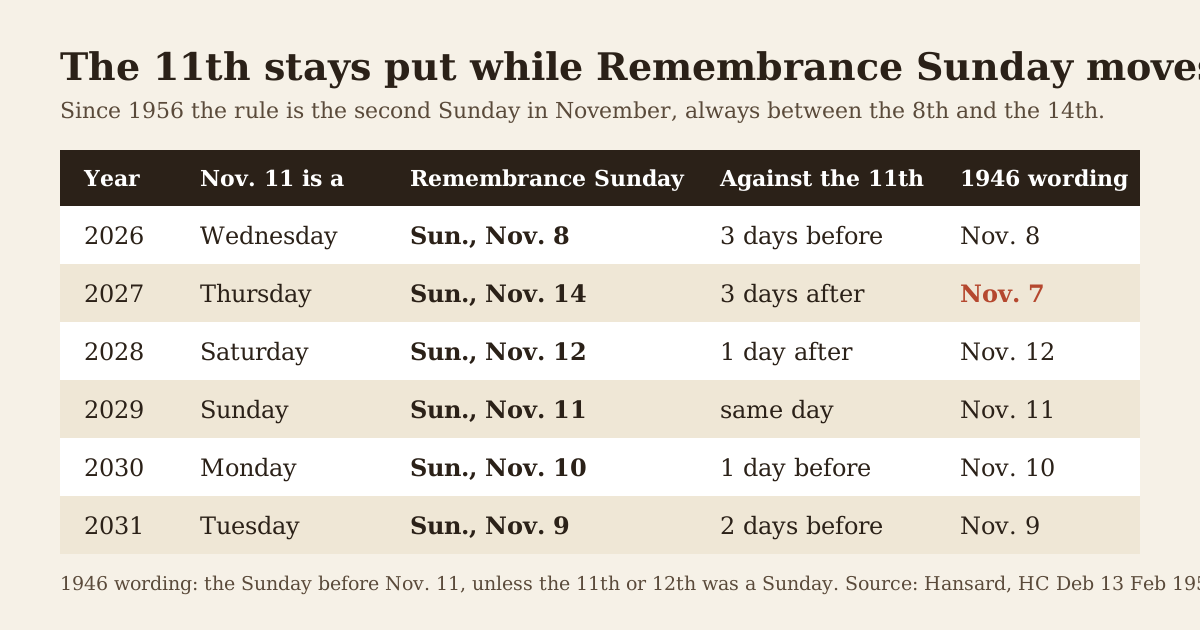
Table of Remembrance Sunday from 2026 to 2031 against November 11, showing the date moving between the 8th and the 14th, and the one year in this range, 2027, where the 1946 wording would give November 7.

Why the date moves

November 11 is fixed. Remembrance Sunday is tied to a weekday, so it slides around it. The second Sunday of a month can only be the 8th, 9th, 10th, 11th, 12th, 13th or 14th, which means the service is never more than three days from the 11th. In 2026 it comes three days before. In 2027 it comes three days after, on November 14. In 2029 the 11th is itself a Sunday, so the two coincide.

That answers the question most people type: it is not always after the 11th, and not always before it either.

What the rule used to be

The first postwar rule was looser. In the Commons answer of 13 February 1958, the Home Secretary said Lord Attlee had announced on 19 June 1946 that Remembrance Sunday would be held on the Sunday before 11 November, unless the 11th or 12th of November were a Sunday. In 1956, he added, Sir Anthony Eden announced a change so that it would always be the second Sunday in November. The stated reason was to avoid inconvenience.

Worked through, the two versions agree in most years and split when November 11 falls on a Thursday or a Friday. Our reading of the 1946 wording gives November 7 for 2027, where the second-Sunday rule gives November 14. The same split happened in 2022: November 11 was a Friday, the 1946 wording points to November 6, and GOV.UK's national service page is dated Sunday 13 November 2022.

The 1958 answer was a reply to an MP who asked for the national day to move from November to May, when the war in Europe ended. The Home Secretary declined, saying many strong associations tie the day to November and that the date should only change with great care.

How the day is marked

The Cenotaph on Whitehall was unveiled by George V in 1920, according to the Royal Family's website, and every monarch since has laid a wreath on Remembrance Sunday. As Big Ben strikes eleven, a gun is fired and two minutes of silence follow, according to the same page. The King, political leaders, serving and former members of the Armed Forces and Commonwealth High Commissioners gather at its foot, and wreaths of poppies are laid.

Poppies come from the Royal British Legion's appeal. A GOV.UK statement on the Prime Minister's yearly donation calls it a tradition dating back to 1921. Armistice Day itself recalls the 1918 armistice that ended fighting in the First World War, a date the National Archives traces in its piece on the road from Armistice to Veterans Day.

Remembrance Sunday and Veterans Day

Both grew from November 11, but they now work in opposite ways. The US federal holiday is fixed to the 11th by statute, as Veterans Day 2026 explains, and only the day off moves when the 11th lands on a weekend. The British observance is fixed to a Sunday and lets the date float. In 2026 the two fall three days apart, and in 2029 they land on the same day.

Canada keeps the same armistice under the name Remembrance Day, on November 11. Its Thanksgiving was merged with Armistice Day from 1921 to 1931, when the day went back to October. Canadian Thanksgiving sets out that stretch of the history.

Frequently asked questions

Is Remembrance Sunday always after 11th?

No. The day tracks a weekday, so it lands anywhere from the 8th to the 14th. Count 2026 (the 8th) as early, 2027 (the 14th) as late, and 2029 as dead on the 11th.

When is Remembrance Sunday in 2026?

Sunday, November 8, 2026. Armistice Day is the Wednesday after, November 11.

Does America do Remembrance Sunday?

Americans mark Veterans Day on November 11, a federal holiday named in 5 U.S.C. §6103. The Sunday rule covered on this page is a British one, announced by Attlee in 1946 and Eden in 1956.

Is Remembrance Sunday a bank holiday?

It is absent from the published UK bank-holiday calendar. Marking the occasion on a Sunday adds no statutory holiday entitlement, although an employer’s own leave arrangements can differ.

What time is the silence on Remembrance Sunday?

11am. Going by the 2025 programme, the guns fire at 11:00 and the ceremony finishes at 11:25. No 2026 programme was identified when this page was written on October 8; consult the official event notice before attending.

Why did the rule change in 1956?

Hansard offers a single reason, avoiding inconvenience, and says no more. From 1956 the day was always the second Sunday.

Embed this countdown

Paste this into any blog post or web page to show a live "days until Remembrance Sunday 2026: Date and Why It Moves" counter, free to use, with the attribution link staying in place.

Nearby on the calendar

Reader's note

Was this day's page useful?

Published by DayAlmanac