
.jpg)
September 15 to October 15, not a calendar month
National Hispanic Heritage Month runs from September 15 through October 15 every year. That's a real oddity on this calendar: most federally designated months here, Domestic Violence Awareness Month among them, track a single calendar month start to finish. This one opens in the middle of September and closes in the middle of October, crossing two calendar months every year without exception.
The range wasn't picked as a round number. September 15 is the shared independence anniversary of five Central American countries (Costa Rica, El Salvador, Guatemala, Honduras, and Nicaragua), all of which declared independence from Spain on that date in 1821. Mexico's independence day, September 16, and Chile's independence day, September 18, both fall within the first few days of the window. October 12, long marked across much of Latin America as Día de la Raza, lands near the end of it. The 31-day span was drawn to bracket that whole cluster of national days, not to round out a tidy month.
Nineteen cosponsors, one future President
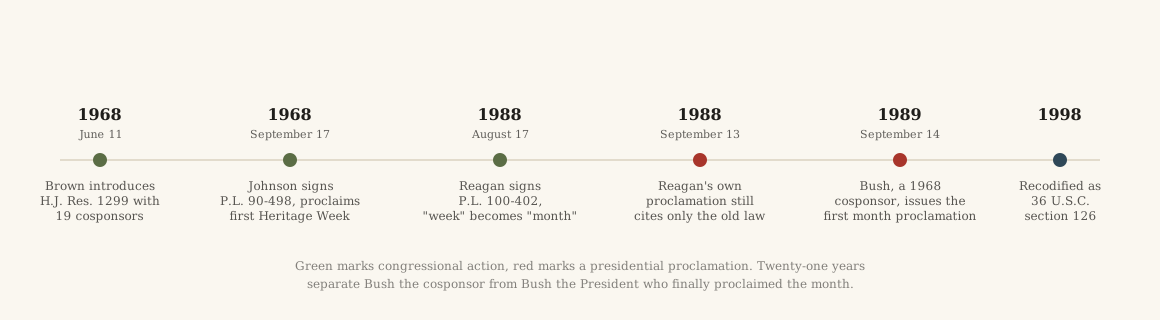
On June 11, 1968, California Congressman George E. Brown introduced House Joint Resolution 1299, asking the President to proclaim a week each September in recognition of the country's Hispanic population. Nineteen cosponsors signed on, including two of the small number of Hispanic members then serving in Congress, Edward R. Roybal of California and Henry B. Gonzalez of Texas, alongside representatives from Colorado, New Mexico, Arizona, and one from New York. One cosponsor was a Republican freshman from Texas: George H.W. Bush.
The bill had an easy path. It passed the House with a single amendment that trimmed its supporting language down to a short operative text, then cleared the Senate Judiciary Committee without further changes. President Lyndon Johnson signed it into law on September 17, 1968, as Public Law 90-498, and issued the first National Hispanic Heritage Week proclamation, Proclamation 3869, that same day.
The bill that died, and the one that didn't
Nineteen years later, in 1987, Representative Esteban Torres of California introduced H.R. 3182 to stretch the single week into a full month, arguing that a week didn't leave enough time to properly coordinate events and activities. Torres's bill died in a House committee and never reached a vote.
What actually became law was a separate bill. Senator Paul Simon of Illinois introduced a companion measure, S. 2200, that used the same core change Torres had proposed: deleting "week" from the 1968 statute and inserting "month." Simon's bill passed both chambers, and President Reagan signed it as Public Law 100-402 on August 17, 1988, fixing the new range at September 15 through October 15. It's a detail a lot of retrospectives flatten, crediting Torres alone with creating the month. His bill supplied the idea and the language Simon's bill reused, but it was Simon's Senate version, not Torres's House one, that Reagan actually signed.
The month nobody proclaimed in 1988
Here's the part most calendar sites skip. Reagan signed the new month-long law on August 17, 1988, weeks before that year's September 15 start date. But when the White House issued its proclamation that September, it wasn't for a month. Proclamation 5859, dated September 13, 1988, designates "the week beginning September 11, 1988" as National Hispanic Heritage Week, and cites only "the Congress, by Joint Resolution approved September 17, 1968 (Public Law 90-498)" as its authority. There is no mention of the new law Reagan himself had signed a month earlier.
The first proclamation to actually invoke the amended law came from Reagan's successor. On September 14, 1989, President George H.W. Bush proclaimed "the month beginning September 15, 1989, and ending October 15, 1989" as National Hispanic Heritage Month, citing Public Law 90-498 "as amended," language that acknowledges the 1988 change. By then, Bush was 21 years removed from being one of the freshman cosponsors of Brown's original week-long bill.
Fixed in the U.S. Code, observed unevenly since
The observance got a permanent home in federal law in 1998, when Congress recodified Title 36 of the U.S. Code, the "Patriotic and National Observances" title, and the statute became 36 U.S.C. § 126. The text is short: the President is "requested" to issue a proclamation each year designating September 15 through October 15 and calling on the country, "especially the educational community," to observe it.
That standing law is why the date range itself has never been in real dispute the way some observances on this calendar have been. What varies from year to year is the timing of the proclamation, not the dates it covers. In 2025, the White House proclamation wasn't signed until September 22, according to the Federal Register's own record of the document, a full week after the observance had already begun and later than each of the four proclamations issued during the same President's first term, all of which had gone out at least a day before September 15.
This calendar carries a small cluster of federally designated months with a similar shape: grassroots or congressional origins, formal recognition years after the fact, and a modern practice of presidential proclamation that doesn't always move in lockstep with the underlying law. Domestic Violence Awareness Month, whose October dates overlap the back half of this window, took a different route to federal status. Congress designated it by name for one specific year, 1989, then renewed that designation once more for 1991, before Presidents began proclaiming the month on their own authority rather than under a standing law like this one. National Grandparents Day, observed just days before this window opens each year, needed a presidential proclamation and a separate act of Congress a year apart before its own date was settled. National Hispanic Heritage Month carries no legal holiday status either: no federal offices close and no paid leave attaches to it anywhere in the country, and it does not appear among the holidays listed at 5 U.S.C. § 6103(a).