The current chart, checked directly rather than assembled from a dozen retail blogs
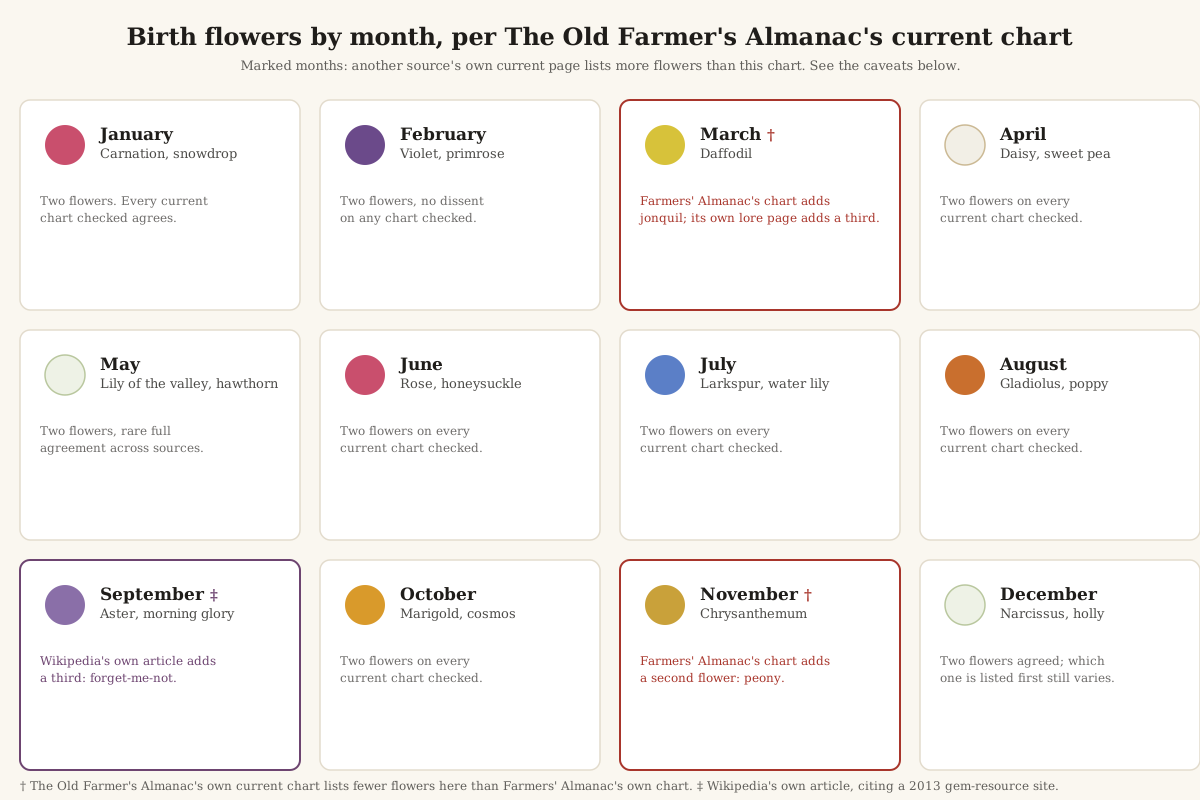
This calendar has now published a separate page for all twelve months' birth flowers, one at a time, over the course of several weeks. Laid out together instead, checked against The Old Farmer's Almanac's current chart the week this page went up, the full run reads: January is carnation and snowdrop. February is violet and primrose. March is daffodil, styled on the Almanac's page as "Daffodil & Jonquil" even though the text calls jonquil just another name for the same flower rather than a second bloom. April is daisy and sweet pea. May is lily of the valley and hawthorn. June is rose and honeysuckle. July is larkspur and water lily. August is gladiolus and poppy. September is aster and morning glory. October is marigold and cosmos. November is chrysanthemum alone, with no second flower on the page. December is narcissus, most often the paperwhite, and holly.
Ten of the twelve months carry a clear pair under that current framing, and two carry a single flower: March, where the second name turns out to describe the same plant, and November, where nothing on the page names a second flower at all. This calendar's page on birthstones by month found a parallel shape in the gem trade's chart, where two different months turned out to be the ones a trade group's current list ran short on.
No 1912 meeting behind this one
Birthstones trace to a specific date: a 1912 Kansas City meeting where a US retail jewelers' trade group adopted a standard chart, later revised on the record three more times. Birth flowers have no equivalent founding meeting. Wikipedia's own article on the broader tradition, floriography, traces the modern "language of flowers" fashion to Ottoman Constantinople's 18th-century tulip culture, reaching Britain through the poet and traveler Mary Wortley Montagu after her stay there in the 1710s. The first published dictionary attaching fixed meanings to individual flowers, per that same article, was Joseph Hammer-Purgstall's Dictionnaire du langage des fleurs in 1809; the first true floriography dictionary followed in 1819, written by Louise Cortambert under the pen name Madame Charlotte de la Tour. The English writer Robert Tyas added his own version in 1836.
None of those three books is a birth-flower chart specifically, and none of them is the document any current almanac cites as its chart's origin. The modern month-by-month birth-flower list appears to be a later distillation of that general Victorian flower-meaning fashion, assembled by almanacs and florists rather than adopted at any single meeting a source names. That absence of a founding date is itself the difference from birthstones worth stating plainly, rather than papering over with a vague "since Victorian times" the way many calendar pages do.
March and November break the pattern
Checking The Old Farmer's Almanac's current page against Farmers' Almanac's current page, flower by flower, turns up two months where the two disagree, and on both of them the Almanac carries fewer flowers than its counterpart.
March is the more tangled case. The Old Farmer's Almanac heads the month "Daffodil & Jonquil," but its body text says the March birth flower "is the daffodil, referred to as the jonquil (which is simply a type of daffodil)": one flower under two names, not two flowers. Farmers' Almanac's current chart lists March as "Daffodil and Jonquil" without that caveat, treating jonquil as a second, distinct bloom (it is in fact a specific species, Narcissus jonquilla, not a synonym for daffodil in general). Farmers' Almanac's dedicated March lore page goes a step further still, naming one other flower: cherry blossom, which its text says "is sometimes considered the March birth month flower," particularly in Japanese culture. Farmers' Almanac's chart page and its lore page don't agree with each other on whether March has two flowers or three.
November is the cleaner case. The Old Farmer's Almanac's current chart, on both its roundup page and its dedicated November page, names only the chrysanthemum; neither page mentions a second flower anywhere. Farmers' Almanac's current chart pairs the same chrysanthemum with a second flower, peony. A shopper checking one Almanac page for November's birth flower gets one answer; checking the other gets two.
A third flower, and neither almanac carries it
Wikipedia's September article states plainly that "the birth flowers are the forget-me-not, morning glory and aster," three flowers rather than the two either almanac's current chart names for the month. The claim traces, per Wikipedia's cited source, to a gem-and-jewelry resource site's birth-flower page, archived in 2013. Neither The Old Farmer's Almanac's current September page nor Farmers' Almanac's current September page mentions forget-me-not at all. It isn't possible to say from here whether that third flower reflects an older tradition the two almanacs have since dropped, or a single compiler's addition that Wikipedia picked up and neither almanac ever carried in the first place; what's checkable is that today, on three current pages, one names three flowers and two name two.
December turns up a smaller wrinkle, worth a line rather than a whole finding. Both almanacs agree the month's flowers are narcissus, usually specified as the paperwhite, and holly. But The Old Farmer's Almanac's dedicated December page doesn't agree with its own roundup page on the order: the dedicated page's title reads "December Birth Flowers: Holly and Narcissus," holly first, while the roundup page's body text calls narcissus the "primary" flower and holly the "secondary" one. Both flowers are on both lists either way; it's only the ranking that wobbles, and only within one organization's site.
Why one flower can have two names and two histories
A recurring shape across this calendar's twelve individual birth-flower pages is a plant carrying two unconnected names, one botanical and one common, each with its own separate origin. Rose and honeysuckle, June's pair, split that way: honeysuckle's genus name Lonicera honors a 16th-century German botanist who had nothing to do with the plant, while the English word "honeysuckle" comes from an unrelated Old English phrase that originally described clover. Larkspur, one of July's two flowers, does it from the opposite direction: its scientific name Delphinium describes the shape of its nectary, not the lark's spur its English name refers to.
A second recurring shape is a flower whose species count keeps moving. March's daffodil has been counted anywhere from 6 species by Linnaeus in 1753 to 87 by one modern registry, depending on how narrowly "species" is drawn. November's chrysanthemum carries a split identity of its own: Japan's Imperial Seal and highest civilian honor on one side, a graveside flower tied to All Saints' Day across much of Catholic Europe on the other, the same bloom read as opposite things by two different cultures rather than by two different trade groups. No single body has ever had the standing to settle any of this the way a court can settle a legal question. Each source, checked on its own current page, is accurately reporting what it currently says. The chart above is what those pages currently say; the two months flagged are where they currently don't agree, and this page will note it if a future revision closes either gap.