The whole month, every year
Ovarian Cancer Awareness Month runs the full 30 days of September, with no nth-weekday arithmetic or floating window to work out. The table above lists September 1 as each year's start; the observance continues through September 30, matching how the National Ovarian Cancer Coalition, the American Cancer Society, and every confirmed federal proclamation describe it.
What takes real digging to sort out is not the calendar but the paperwork behind it: which branch of government acted first, which year the full month was actually proclaimed, and how firm that recognition really is. Most calendar aggregator sites give the month a one-line mention and move on to the next date.
A presidential week, then a nonprofit's month
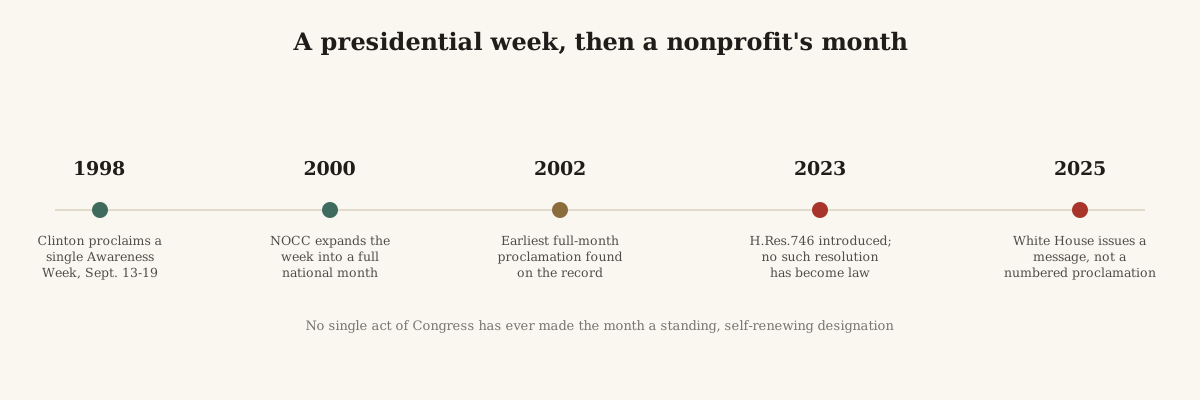
The observance's federal history began with President Clinton's Proclamation 7120, issued September 12, 1998, which named September 13 through 19 of that year National Ovarian Cancer Awareness Week — a single week, not a month, and a real government document recorded in the U.S. Statutes at Large. The advocacy behind it was not new, though: the National Ovarian Cancer Coalition (NOCC) had already been working on the disease's behalf for seven years by then, since its founding as a grassroots group in Boca Raton, Florida, in 1991, and its 1995 incorporation as the country's first national ovarian-cancer nonprofit.
NOCC is the organization that turned that single week into an annual, month-long campaign. NOCC's own materials date the expansion to 2000, two years after Clinton's proclamation, and describe the goal plainly: a single week of federal attention was not enough time to reach patients, families, and physicians with information about a cancer that, at the time, had far lower public visibility than breast cancer.
A contested year, and a confirmed one
Sources close to the observance, including NOCC's own awareness-month page, date the first full-month presidential proclamation to September 2001. That specific document could not be located on any presidential archive checked for this page, which is worth stating plainly rather than repeating a secondhand date as though it had been read directly.
What can be confirmed directly, through a Federal Register filing with its own document number, is Proclamation 7587, issued for September 2002. That proclamation estimated more than 23,000 American women would be diagnosed with ovarian cancer in 2002 and almost 14,000 would die from it, and it stated that ovarian cancer caught at its earliest, localized stage carries a 95 percent five-year survival rate — a figure meant to make the case for awareness and early detection, not a general survival statistic for every diagnosis regardless of stage.
Proclamations continued in most years after that, though the record found during research for this page is not a complete unbroken chain: confirmed documents exist for 2002, 2013, 2014, 2016, 2021, 2023, and 2024, each a separately numbered proclamation. September 2025 broke the specific format, if not necessarily the tradition: the White House issued a "Presidential Message" that year rather than a numbered proclamation, the only year on this list where that happened.
Congress has tried repeatedly, and nothing has passed into law
No act of Congress has been found establishing Ovarian Cancer Awareness Month as a standing observance. What exists instead is a pattern of individual House members introducing a fresh resolution nearly every year, naming that specific September: H.Res.746 for 2023, H.Res.1508 for 2024, and H.Res.775 for 2025.
These resolutions do not automatically become anything. GovTrack.us's own tracking shows H.Res.1508, the 2024 resolution, never received a vote after being referred to committee — the ordinary fate of a "supporting the designation of" resolution in the modern House. No Senate companion resolution for any of these specific years was confirmed to have passed during research for this page, and no law bearing this name has been found on the record at all. Lung Cancer Awareness Month at least secured one unanimous Senate resolution, in 2020; this observance's congressional record, by comparison, is a string of introduced-but-unvoted House resolutions rather than any confirmed Senate action.
The teal ribbon
Teal is the ribbon color associated with ovarian cancer awareness, used consistently across NOCC, the Ovarian Cancer Research Alliance (OCRA), and international partners including the World Ovarian Cancer Coalition. It is a newer symbol than the pink ribbon for breast cancer, and its exact origin is thinner on the record than the observance's own founding dates.
The most common attribution found during research for this page credits the ribbon's introduction to the Ovarian Cancer National Alliance (OCNA), a precursor organization to today's OCRA, sometime around 1994 or 1995, during the broader early-1990s spread of awareness ribbons that followed the pink ribbon's own rise. That specific date and organization, however, rest on secondary sources of modest authority rather than an official history page making the claim in its own words, so it is presented here as the most repeated account rather than a settled fact.
Why 'silent killer' is a contested label
Ovarian cancer is commonly described as a silent killer, and the label has real statistics behind the underlying concern even where advocates and researchers dispute the word "silent" itself. The American Cancer Society estimates roughly 21,010 new U.S. diagnoses and about 12,450 deaths for 2026, a lifetime risk of about 1 in 91 for being diagnosed and about 1 in 143 for dying of the disease. The five-year relative survival rate across all stages combined is 51 percent, but that figure hides an enormous range by how early the cancer is caught: 92 percent for cancer still localized to the ovary, 71 percent once it has reached nearby structures or lymph nodes, and 32 percent once it has spread further.
The reason so many cases are caught late is the actual substance of the "silent killer" debate. No screening test has been shown effective enough for general use — the U.S. Preventive Services Task Force gave ovarian-cancer screening a Grade D recommendation in 2018, meaning it recommends against it for women without known risk factors, because large trials failed to demonstrate a net benefit. Roughly 70 percent of cases are still diagnosed at an advanced stage. Symptoms do exist, though, and are not truly absent: bloating, pelvic or abdominal pain, feeling full quickly after eating, and increased urinary frequency or urgency are the most commonly reported, and a 2000 survey of 1,725 women with the disease found 95 percent reported noticing at least one such symptom at some point before their diagnosis. Several researchers, writing for outlets including The Conversation, have argued the "silent killer" framing is itself part of the problem: the symptoms are real and reported, just vague enough to be mistaken for digestive issues, which delays diagnosis more through misattribution than through any true absence of warning signs.
Not the only ovarian cancer date on the calendar
Two other observances get confused with the U.S. September month, and neither is the same thing. World Ovarian Cancer Day falls on May 8 every year, an international observance launched in 2013 by the World Ovarian Cancer Coalition, a partnership now including more than 200 advocacy organizations across dozens of countries, with a focus on research funding and equal access to screening and treatment worldwide rather than the U.S. federal-proclamation history documented above.
The United Kingdom runs a separate, differently timed campaign entirely. Target Ovarian Cancer, Ovarian Cancer Action, Macmillan Cancer Support, and The Eve Appeal mark Ovarian Cancer Awareness Month in March, citing over 7,000 UK diagnoses a year and noting that roughly two-thirds are still caught at a late stage — the same core early-detection problem documented above, tracked by a different set of charities on a different month entirely.
This calendar has now covered several observances built around the same basic pattern: a nonprofit or a single advocacy campaign builds public attention first, and federal government recognition, where it exists at all, follows on its own separate and often much later timeline, without ever quite becoming a standing law. Breast cancer's own awareness month is this pattern's strongest federal case, with actual public laws passed in the early 1990s; the lung-cancer observance waited twenty-two years for even a single Senate resolution; Suicide Prevention Month, observed the same September, has its own separate and equally incomplete federal history. Ovarian Cancer Awareness Month sits closer to the lung-cancer end of that range: real presidential attention most years, but no law Congress has ever passed.