
The whole month, every year
Lung Cancer Awareness Month runs the full 30 days of November, with no nth-weekday arithmetic or floating window to work out. The table above lists November 1 as each year's start; the observance continues through November 30 in every case, matching how GO2 for Lung Cancer, the American Lung Association, and every federal proclamation on record describe it.
What takes real digging to sort out is not the calendar but the paperwork: which organization actually started this, in what year, and whether any government body has ever made the recognition permanent. Most calendar aggregator sites give the month a one-line mention and move on.
A patient group's single day, then its month
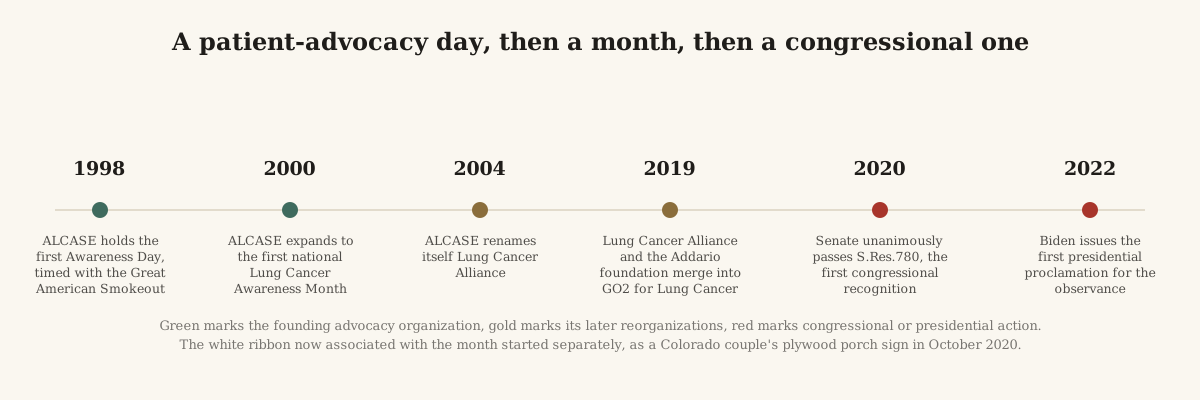
The observance began as the work of people who had lung cancer, not as a government initiative or a corporate campaign. ALCASE, the Alliance for Lung Cancer Advocacy, Support and Education, held the first Lung Cancer Awareness Day on November 14, 1998, and the organization's current materials say the date was chosen to land alongside the American Cancer Society's long-running Great American Smokeout, so a single November week could carry both a quit-smoking push and a lung-cancer-awareness push at once.
ALCASE returned to the idea two years later. In November 2000, the organization expanded that single day into a full Lung Cancer Awareness Month, run nationally and not as a one-off event. GO2 for Lung Cancer, which now carries ALCASE's history forward, states that the month reaches roughly 20 million people every November across the U.S. and beyond, a scale the original 1998 day, aimed at a single week's press cycle, was never built for.
Congress took twenty-two years, and it still isn't permanent
No branch of the federal government touched the observance for over two decades after ALCASE's founding day. That changed on December 1, 2020, when the Senate passed S.Res.780 by unanimous consent, sponsored by Senators Tina Smith of Minnesota and Marco Rubio of Florida, formally designating November 2020 as National Lung Cancer Awareness Month and urging Americans to support early detection and screening.
A Senate resolution of this kind carries no force of law: it does not go to the House for a vote, does not require a presidential signature, and expires with the Congress that passed it. Every subsequent Congress has had to pass a new one naming the new year: S.Res.462 designated November 2021, S.Res.512 designated November 2023, and a House companion, H.Res.960, was introduced for November 2025. That is the same by-year pattern this site has already documented for Breast Cancer Awareness Month, though the two observances didn't get there the same way. Breast cancer's early designations were joint resolutions and outright public laws, which do carry the force of law; lung cancer's have so far only ever been simple resolutions, which don't. The gap between founding and first congressional recognition also ran far longer here: twenty-two years for lung cancer's observance, against five years for breast cancer's.
A presidential proclamation is a separate, later layer again. The earliest one on record is President Biden's proclamation of November 2022, signed October 31 of that year; Biden issued comparable proclamations for 2023 and 2024, and news coverage reported the Trump administration marking the month again in November 2025. No search of presidential archives from 2018 through 2021 turns up an earlier proclamation under this name.
The white ribbon is a separate, later story
The white ribbon now associated with the month did not exist when ALCASE founded it, and it did not come from any of the advocacy organizations behind the observance's history. In the fall of 2020, a Colorado woman named Heidi Nafman-Onda, diagnosed with stage IIIA non-small cell lung cancer two years earlier, grew frustrated after hospital marketing departments repeatedly turned down her requests to mark the coming November. She asked her husband, Pierre, to cut a white ribbon out of plywood for their own front porch, reasoning, in her own words, that "no one can stop me from putting a white ribbon up on my own house."
Pierre lettered the plywood ribbon with a sticker reading "Lung Cancer Awareness," and Heidi posted photos of it to a private Facebook group for lung cancer survivors in Colorado. The response turned their garage into a small ribbon workshop: within six months, the couple had personally made and shipped more than a thousand ribbons, each signed by its maker, to recipients across the United States, Canada, the Philippines, the Netherlands, and Germany, and what started as an unbranded porch project grew into a standing organization, The White Ribbon Project.
What the month does and does not carry with it
Lung Cancer Awareness Month is not a federal holiday: no offices close and no leave attaches to it, the same as every other awareness month this site has covered. What happens instead is decentralized, driven by the same patchwork of advocacy groups, hospitals, and state governors' offices that built the observance in the first place. Individual state proclamations, like North Carolina's, run alongside the federal one most years, and the American Lung Association publishes its own annual "State of Lung Cancer" report each November tracking screening and survival rates state by state.
This calendar has now covered several November observances that share a version of this same arc: a single advocacy organization builds the tradition first, and federal recognition, where it exists at all, arrives on its own separate and much later timeline. Diabetes Awareness Month traces informally to a 1975 declaration but only received its first confirmed presidential week in 1981 and its first full-month proclamation in 1982. National Epilepsy Awareness Month has an even starker federal record: Congress tried three separate times, in 2002, 2003, and 2011, to pass a resolution recognizing it, and none of the three ever passed. No-Shave November, which shares the same 30 days, has never had any federal recognition, and its only government nod was a one-year Louisiana state resolution for November 2014, a reminder that Lung Cancer Awareness Month's 2020 Senate resolution and 2022 presidential proclamation put it on firmer government footing than most of the observances crowding the same month, even without a standing statute behind it.