The national date and local court schedules
National Adoption Day 2026 falls on Saturday, November 21, matching the observance's consistent rule: the Saturday before Thanksgiving. This page checked that rule against independent local reporting for two straight years, and it held every time: North Carolina, Maryland, and Colorado court systems each independently reported events on November 23, 2024, and Maryland's circuit courts confirm November 22, 2025. The organizers' current homepage states the 2026 date outright: "Saturday, November 21, 2026."
National Day Calendar’s current page gives November 21, 2026 and the same future dates generated here: November 20, 2027; November 18, 2028; and November 17, 2029. National Today’s checked page gives Sunday, November 22 for 2026. The former disagreement between both sites and the coalition should not be presented as unchanged. Readers attending a court event should also check its own schedule rather than assume every local ceremony uses the coalition’s national Saturday.
Where it actually started: a courthouse backlog, not a campaign
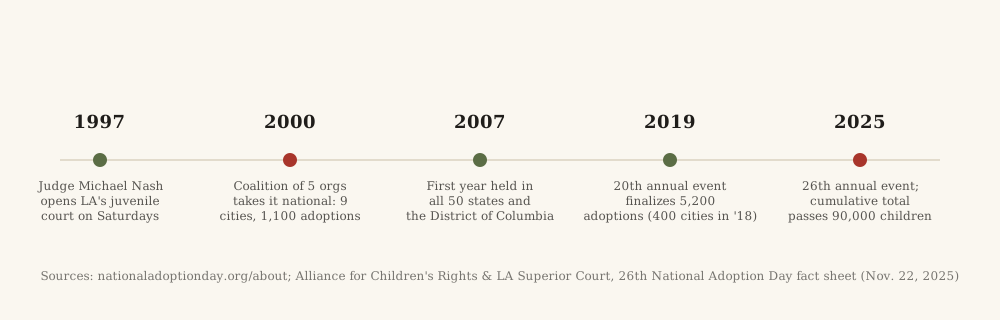
The event began as a practical fix for case backlog, not an awareness campaign. In 1997, Michael Nash, then the presiding judge of Los Angeles County's Juvenile Court, one of the busiest in the country, started opening his courtroom on Saturdays and drawing on volunteer court staff and pro bono attorneys to finalize adoptions that would otherwise sit in queue. That Los Angeles "Adoption Saturday" program, run in partnership with the county's Department of Children and Family Services, the Alliance for Children's Rights, and Public Counsel, has finalized more than 46,000 adoptions since it began and still runs four times a year.
Three years later, five organizations took the same model national. On November 18, 2000, the Dave Thomas Foundation for Adoption, the Congressional Coalition on Adoption Institute, the Alliance for Children's Rights, the Children's Action Network, and the Freddie Mac Foundation coordinated the first National Adoption Day: nine cities opened their courts that Saturday and finalized 1,100 adoptions in a single day. Growth from there was fast by the coalition's numbers, tracked as two separate series that do not land in the same years: participating cities grew from 17 in 2001 to 340 in 2009 to 400 by 2018, with the District of Columbia and all 50 states first covered back in 2007; adoptions finalized in a single day grew from 1,500 in 2001 to 4,835 in 2009 to 5,200 at the 20th annual event in 2019. The 26th annual event, held November 22, 2025, pushed the coalition's cumulative total, children who found a permanent family specifically through a National Adoption Day event since 2000, past 90,000.
How many children are actually waiting? Three different numbers are in circulation
The statistic attached to this observance, "children waiting to be adopted from foster care," is repeated at three noticeably different scales depending on which source is quoted. The organizers' current homepage rounds up to "more than 100,000." National Today's page for the day states "more than 125,000." Neither figure carries a publication date or a direct citation to a specific report.
The dated federal snapshot discussed here comes from AFCARS, the Adoption and Foster Care Analysis and Reporting System run by the U.S. Children's Bureau. Preliminary FY2024 estimates, released September 5, 2025 (Report No. 32) and cited on the coalition's 2025 fact sheet, put 70,421 of the 328,947 children in out-of-home foster care nationally, 21 percent, on a case plan with adoption as the permanency goal; a separate category, 49,994 children, is reported as legally free for adoption, meaning parental rights have already been terminated. A separate tally from the National Council for Adoption's AFCARS write-up puts the same "waiting to be adopted" figure at 70,418, three off from the fact sheet's number, without enough dated extraction information here to establish why the counts differ. The three-child discrepancy should not be assigned to different pull dates as a fact.
Numerically, 70,421 is about 30 percent below 100,000 and 44 percent below 125,000, but those calculations are not valid measures of a change in the waiting population. Older AFCARS waiting-child counts included children with an adoption goal or terminated parental rights, with stated exclusions, while 70,421 counts the adoption-plan category. The Children’s Bureau’s FY2023 dashboard explanation also says earlier counts should be considered separate because the reporting population changed. Around 2017 the older series counted roughly 123,000 waiting children. Keeping that year and definition attached is more informative than treating the new category as the same statistic cut nearly in half.
A day, not the month, and the two get different federal treatment
November is also National Adoption Month. Its 2025 White House proclamation was issued November 17 and published in the Federal Register three days later. The day also received federal recognition: S.Res.513, agreed to by the Senate November 20, 2025, designates November 22, 2025 as National Adoption Day and November 2025 as the month. This is a year-specific Senate expression, without statutory force. No recurring designation statute or separate presidential day proclamation was identified in the consulted set; that limited finding must not be recast as no federal recognition at all. Courts and the coalition organize the practical events.
State and county government offices do participate directly, which can blur that line for a casual reader. Court systems and governors' offices in states including North Carolina, Maryland, Colorado, and California issue their own press releases and, in some years, gubernatorial proclamations recognizing the day locally. None of that amounts to a federal designation, though, and the coalition's materials do not claim one.
Not the first stale statistic this calendar has found
The statistics call for attention to year, scope and definitions. National Cat Day contrasts repeated shelter estimates with dated 2025 ASPCA intake and euthanasia data; that does not establish that every measure of shelter conditions improved. Banned Books Week and Domestic Violence Awareness Month distinguish separate forms of federal recognition. Adoption Day likewise needs both distinctions: its Senate recognition is nonstatutory, and its older waiting-child estimates are not directly interchangeable with the FY2024 adoption-plan category.