
The whole month, every year
Domestic Violence Awareness Month covers all 31 days of October, not a single date or a floating week inside it. That makes the date question almost trivial by the standards of this calendar: there is no nth-weekday arithmetic to compute, no rival set of dates from a different organization, and no table to double-check each year. October 1 marks the start of each year's observance below; it runs through October 31 in every case.
The simplicity stops at the calendar, though. What has genuinely changed over more than three decades is not the dates but the paperwork behind them: whether a fresh act of Congress stands behind a given year's observance, or whether it now runs on custom alone. That distinction, not the date range, is the part most calendar sites skip past.
From one day to one month, 1978 to 1987
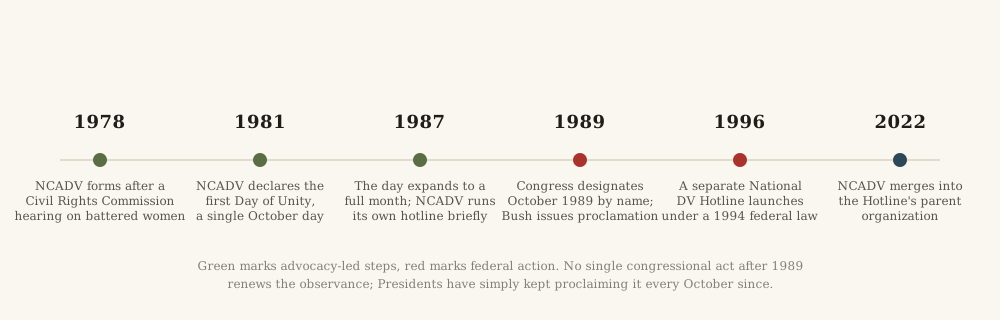
The National Coalition Against Domestic Violence formed in January 1978, out of a United States Commission on Civil Rights hearing titled "Consultation on Battered Women: Issues of Public Policy." It became the country's first national organization built specifically around shelters and support services for battered women and their children, at a time when there was little of either: fewer than a handful of dedicated shelters existed nationwide before the mid-1970s.
NCADV's first observance, in October 1981, was a single "Day of Unity," intended to connect advocates who had mostly been working in isolation, state by state. The jump from one day to a full month took until October 1987, when NCADV held the first Domestic Violence Awareness Month and, separately, ran its own toll-free hotline for a period. That 1987 hotline is easy to confuse with the hotline most people call today; it was not the same organization, and the two would not come under one roof for another 35 years.
1989: Congress designates it, for one specific year
Domestic Violence Awareness Month got its federal recognition through Senate Joint Resolution 133, enacted as Public Law 101-112 on October 6, 1989. As Bush's proclamation itself quotes it, Congress "designated October 1989 as 'National Domestic Violence Awareness Month' and...authorized and requested the President to issue a proclamation." Five days later, on October 11, 1989, Bush did exactly that in Proclamation 6043, the first presidential proclamation of this observance on record.
What is easy to miss is that this was, on paper, a one-year designation, not a standing law that automatically renews every October. Congress went back and did it again at least once: Senate Joint Resolution 73 designated October 1991 the same way, and Bush issued a second proclamation, Number 6340, that September. Whether Congress kept passing a fresh resolution every single year after that is not something any one source lays out cleanly, but by the time later administrations proclaimed the month, the practice had visibly changed.
A federal fixture that nobody has to keep renewing
By 2021, President Biden's proclamation cited no accompanying joint resolution at all: he proclaimed "National Domestic Violence Awareness and Prevention Month" under "the authority vested in me by the Constitution and the laws of the United States," full stop. Somewhere between the early 1990s and the 2020s, the month had become something Presidents simply do every October on their own authority, not something Congress hands them fresh each year. Individual members of Congress have kept a version of the earlier custom alive on their own, most persistently Representative Al Green, who has introduced his own "Original National Domestic Violence Awareness Month Resolution" most years since at least 2005. Two of the earlier ones did reach the House floor and pass, a 404-0 roll call for H.Con.Res. 209 in 2005 and a voice vote for H.Res. 817 in 2009, but neither cleared the Senate to become law, and a resolution that stalls there or never gets a floor vote at all, as most of Green's later versions have, carries no legal force of its own. A different kind of one-year anomaly shows up on this site's Prostate Cancer Awareness Month page: in 2001, the presidential proclamation named November instead of the September the Senate had actually requested.
The White House's record on this observance is not entirely consistent, either. Bush's 1991 proclamation states that "every autumn since 1985, we have set aside National Domestic Violence Awareness Month," but no proclamation, joint resolution, or advocacy timeline places the first observance before 1987 as a month or 1989 as a federal proclamation. It is a small, uncorrected slip in an otherwise precisely dated official record, the kind of detail most calendar sites smooth over rather than flag.
The observance's own name and format have also shifted by administration. Bush's original proclamations called it "National Domestic Violence Awareness Month"; Biden's called it "National Domestic Violence Awareness and Prevention Month" and issued it as a formal Proclamation; the White House's 2025 statement returned to the shorter name but issued it as a "Presidential Message" instead of a Proclamation. None of that changes the dates. It does mean a reader comparing two years' official statements side by side will notice the title and the format read differently depending on which October it is.
Two hotlines, one merged organization
NCADV's short-lived 1987 hotline is often blurred together with the hotline most people call today. The National Domestic Violence Hotline, reachable at 1-800-799-7233, is a separate creation: it was authorized when President Clinton signed the Violence Against Women Act on September 13, 1994, funded the following year through a one million dollar grant to the Texas Council on Family Violence, and took its first call on February 21, 1996. For more than two decades, NCADV and the National Domestic Violence Hotline were separate organizations with overlapping missions and, at times, overlapping messaging about this same October observance.
That changed in 2022, when NCADV merged into the Hotline's parent organization and gave up its own independent nonprofit status. Today, ncadv.org redirects visitors straight to TheHotline.org, and the Domestic Violence Awareness Month materials once published under NCADV's own name live there instead. A reader who finds an older page still crediting NCADV alone as the month's sole current organizer is looking at a description that predates the merger.
How the month is actually observed
Domestic Violence Awareness Month carries no legal holiday status: no federal offices shut down, no employee earns extra time off because of it, and nothing about it is mandatory for any workplace or school. What happens instead is decentralized and annual: state coalitions, shelters, and advocacy groups run their own local events throughout October, loosely tied together by a shared theme chosen each year, such as 2025's "With Survivors, Always" from the Hotline and its partner the Domestic Violence Awareness Project. Purple is the color most commonly associated with the campaign, worn at vigils and shared on social media. Within the month, the first Monday is set aside as the Day of Unity, a direct descendant of NCADV's original 1981 observance and the closest thing the month has to its own founding anniversary.
One thing this month is not: Teen Dating Violence Awareness Month, a separate campaign run each February through loveisrespect.org and aimed specifically at abuse in teenage dating relationships. It shares an audience and a cause with the October observance but runs on its own calendar, not as a subset of this one.
Domestic Violence Awareness Month sits alongside a small group of observances on this calendar with a similar shape: founded by an advocacy organization, later picked up by the federal government, and now sustained mostly by custom rather than fresh legislation. Red Ribbon Week, observed the same month, followed almost the same arc, a grassroots campaign that a nonprofit, not a federal agency, has organized every year since 1988. National Grandparents Day needed both a presidential proclamation and a separate act of Congress, a year apart, before its date was fixed. National Sons Day, by contrast, has no federal recognition at all, a useful reminder of how little authority actually backs most "national days." World Mental Health Day, October 10, shares the month and has a founder dated to 1992.