
What National Epilepsy Awareness Month is
National Epilepsy Awareness Month (NEAM) is a US observance held every November, built around education, screening awareness, seizure first aid training, and reducing the stigma still attached to seizure disorders. The Centers for Disease Control and Prevention's most recent national estimate, from 2015 data, puts active epilepsy at 3.4 million Americans, 3 million adults and 470,000 children; a newer CDC survey covering 2021 to 2023 counted more than 3.1 million adults with active epilepsy on its own. The Epilepsy Foundation, the nonprofit that runs the campaign, cites a broader lifetime figure: roughly 1 in 10 people will have at least one seizure in their life, and about 1 in 26 will develop epilepsy at some point.
The month carries no legal status. No federal law creates a day off, and government offices, banks, and schools run a normal November schedule around it. What does mark it is color: purple is the designated awareness shade, worn and displayed under the Epilepsy Foundation's own "Share Your Purple Power" campaign banner, along with wristbands, ribbon pins, and building light-ups in individual cities during the month.
Who started it, and the claim that doesn't hold up
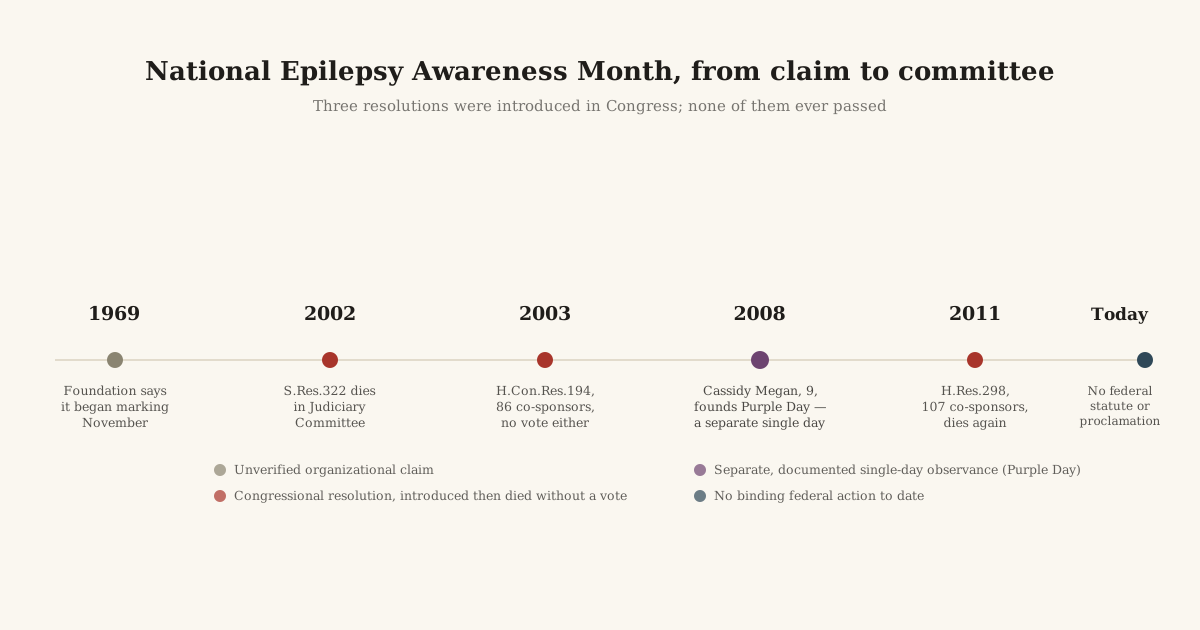
The Epilepsy Foundation, itself founded in 1968, says it began organizing a November campaign the following year, 1969. This calendar found that specific claim on the site of a Foundation regional affiliate, the Epilepsy Foundation of Northeastern New York, rather than on a dated document from the national organization, so it is recorded here as an organizational self-report, plausible and consistently repeated, but not independently checkable the way the congressional record below is.
That same regional-affiliate page, and dozens of other health-media and nonprofit sites, go on to say that "in 2003, the campaign was officially recognized by Congress." Checked against the primary congressional record, that claim does not hold up. No resolution making that designation ever passed either chamber of Congress, in 2003 or in any other year on record. What actually happened in and around that period is a pattern of introduced-but-failed resolutions, detailed below, which is a meaningfully different thing from an "official" congressional recognition, and a distinction this calendar has found blurred on sites that otherwise cover epilepsy carefully.
Three resolutions, and three times they died in committee
The first attempt came from the Senate. On September 5, 2002, Senator Blanche Lincoln of Arkansas introduced Senate Resolution 322 in the 107th Congress, with Senators Susan Collins, Mary Landrieu, Tim Hutchinson, and Peter Fitzgerald as original co-sponsors. The resolution's text, read in full at GovTrack's mirror of the Congress.gov record, would have had the Senate "designate[] November 2002, as 'National Epilepsy Awareness Month'" and "request[] that the President issue a proclamation calling upon the people of the United States to observe the month." It was referred to the Senate Committee on the Judiciary the same day it was introduced. It never received a vote and died when the 107th Congress ended in January 2003.
The second attempt moved to the House the following spring. On May 22, 2003, in the 108th Congress, House Concurrent Resolution 194, "supporting the goals and ideals of 'National Epilepsy Awareness Month' and urging funding for epilepsy research and service programs," was introduced with 86 co-sponsors, a substantial bipartisan list by the standard of most single-issue awareness resolutions. It followed the same path as its Senate predecessor: referred to committee, never brought to a floor vote, dead by the end of that Congress.
A third try followed eight years later. House Resolution 298, introduced June 3, 2011, in the 112th Congress, gathered 107 co-sponsors and expressed "the sense of the House of Representatives that there is need for specified agencies to coordinate and capitalize on existing programs for epilepsy awareness." Its fate matched the first two: committee referral, no vote, no passage. Three separate Congresses, three resolutions, three failures to reach a floor vote in either chamber, a pattern this calendar did not find repeated at quite this scale on any other US health observance it has checked so far.
Not the same as Purple Day
A separate, better-documented observance shares the same purple color and the same general cause but not the same date or the same origin. Purple Day falls on a single day, March 26, and traces to one named person with a specific, well-corroborated founding story: Cassidy Megan, a nine-year-old in Nova Scotia living with epilepsy herself, who held the first Purple Day event on March 26, 2008. "In Grade 3, I didn't want people to feel alone and afraid like I did," Megan told CBC News in 2016. "I wanted them to know there were other people out there and what to do if they see someone having a seizure." Purple Day launched internationally the following year, 2009, backed by the Anita Kaufmann Foundation and the Epilepsy Association of the Maritimes, and by 2016 was marked in more than 100 countries.
The contrast is worth naming directly: Purple Day has a documented founder, a specific first event date, and a traceable international expansion, none of which this calendar could establish for National Epilepsy Awareness Month's broader November campaign. The two observances are frequently run together in the same promotional material, since both use purple and both concern epilepsy, but a reader planning around either one should treat them as genuinely separate: one day in March with a clear founding story, one month in November with an organizational claim this calendar could not independently verify and a congressional history of three resolutions that never passed.
Where the record stands, next to its November neighbors
This calendar has now covered several November observances with different, checkable relationships to federal law, and Epilepsy Awareness Month's is the weakest of the group. American Diabetes Month has an actual proclamation on record, Reagan's Proclamation 4994 in 1982 under Senate Joint Resolution 257, renewed by name again in 1985, before Congress moved to non-binding resolutions after that. No-Shave November sits at the other extreme: a private family's fundraising campaign that has never had any federal recognition attempted at all, successful or not. Epilepsy Awareness Month falls between those two but closer to No-Shave November's end: unlike Diabetes Month, it has no proclamation and no passed resolution on record at any point; unlike No-Shave November, three separate Congresses did attempt one, in 2002, 2003, and 2011, and all three tries died in committee. A resolution introduced and left to die is not the same as no resolution ever being introduced, but neither one adds up to the "Congress declared it in 2003" language that keeps circulating.