What International Men's Day is
International Men's Day is an annual civil-society observance held on November 19, built around six stated objectives: promoting positive male role models, celebrating men's contributions to family and community, focusing on men's health, highlighting discrimination against men and boys, improving gender relations, and working toward a safer world. Those "six pillars" come from the organizing team behind the modern, November 19 version of the day, not from any government or UN body.
It carries no legal holiday status in the large majority of countries that mark it: no day off work, no closed banks or government offices. It spreads mainly through school and university events, parliamentary speeches, workplace campaigns, and social media, coordinated locally rather than through a single central authority. Romania, covered below, is the one country found here where the date carries actual statutory weight rather than informal recognition.
Each year also carries an optional secondary theme, set by volunteer coordinators, not any fixed institution. The 2026 theme, marking the 28th annual observance, is "The Future Is Everyone," a concept first proposed by American writer Lisa Britton in 2020 and adopted as the global theme for 2026.
The date: one name, two observances, for a decade
Calls for a men's counterpart to International Women's Day go back further than most people assume. A 1969 New York Times report noted that "many men have been agitating privately to make February 23 International Men's Day, the equivalent of March 8," but nothing organized came of it for another two decades.
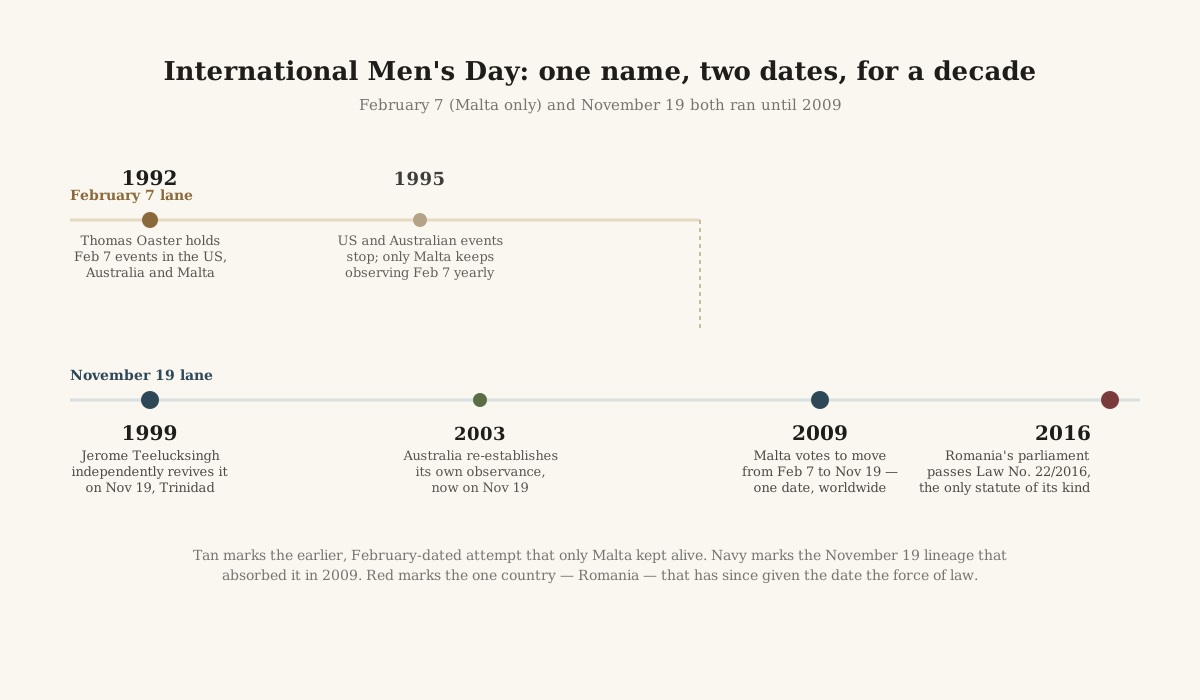
The first real attempt was Thomas Oaster's, in 1992: small events on February 7, held in the United States, Australia, and Malta at his invitation. The US and Australian versions fizzled after a poorly attended 1995 event (Australia later revived its own observance independently, on November 19, in 2003). Malta was the exception: the Maltese Association for Men's Rights kept holding a February 7 event every year from 1994 through 2008, making it, for a time, the single longest-running local IMD observance anywhere.
Jerome Teelucksingh's 1999 revival, on November 19 in Trinidad and Tobago, grew separately and faster, spreading to dozens of countries through the 2000s. For about a decade, two different dates for the same-named observance existed side by side, kept alive mainly by one country each. That ended on January 17, 2009, when Malta's committee voted unanimously to abandon the February date and align with November 19 "to coincide with all the others around the world," as the vote was described at the time. No source checked for this article shows any country still using a different date since.
Who started it, and the match behind the date
The founder is documented and not in dispute: Jerome Teelucksingh, then a history lecturer at the University of the West Indies, revived International Men's Day in Trinidad and Tobago in 1999. His organization's history page gives two reasons for choosing November 19, both personal to him and unconnected to any external body: it was his father's birthday, and it was the date of a Trinidad and Tobago World Cup qualifying match that, in the organization's words, "united the country with their endeavours to qualify for the World Cup."
That match is independently well documented, under a name of its own: "the Shot Heard 'Round the World." On November 19, 1989, in front of a sold-out crowd of about 35,000 at Hasely Crawford Stadium in Port of Spain, Trinidad and Tobago needed only a draw at home against the United States to reach its first-ever World Cup. The US won 1-0 on a second-half goal by Paul Caligiuri, eliminating Trinidad and Tobago and sending the United States to the 1990 World Cup instead, ending a 40-year American absence from the tournament. Trinidad and Tobago's qualifying campaign, in other words, ended in a home defeat, not a celebrated advance.
This does not make Teelucksingh's stated reason inaccurate: uniting a country around a team's effort to qualify is a real thing that can happen regardless of the final score, and his own wording never claims a win. But general retellings of the founding story, on other calendar sites and in casual social posts, sometimes compress "united the country with their endeavours to qualify" into language implying the team succeeded. The record, from Wikipedia's article on the match to US Soccer's retrospective, is unambiguous that it did not.
No United Nations recognition, but Romania made it law
International Men's Day has never been adopted by the United Nations. That is a real contrast with International Women's Day, which the UN General Assembly formally recognized in a 1977 resolution inviting member states to proclaim March 8 as a UN observance, according to the UN's background page on the day. No equivalent resolution exists for November 19. The organizing team's own March 2026 media release states one of its explicit goals for the year is "formal recognition of International Men's Day on the UN calendar," describing it as "the first official day for men or boys, when there are already 13 days for women and girls," language that itself confirms the recognition has not yet happened.
One country is the exception. Romania's Parliament passed Law No. 22/2016, adopted March 4, 2016 and published in Monitorul Oficial no. 169 on March 7, 2016, declaring March 8 "Ziua femeii" (Women's Day) and November 19 "Ziua bărbatului" (Men's Day) in a single two-article statute; the full text, reproduced by the Romanian legal-news site contabun.ro, matches those dates. Two independent Romanian outlets, Mediafax and AGERPRES, both reported the Chamber of Deputies passing the bill on February 3, 2016 by the same tally: 204 votes in favor, 16 against, and 63 abstentions. The law itself is narrow: it declares the date and permits local public authorities to organize events and state broadcasters to air related programming, but it does not create a paid public holiday or a day off work, unlike, for instance, National Grandparents Day, which US federal law fixes to a specific formula (36 U.S.C. § 125) without making it a non-working holiday either. Romania is nonetheless the only country found here with a standing national statute naming November 19 as Men's Day, rather than relying on informal or year-by-year recognition.
Eighty-plus countries, coordinated locally
International Men's Day's spread since 1999 owes as much to individual national organizers as to any central campaign. India's celebration is described by the organizing team as the single largest in the world, driven largely by one person: Uma Challa, a men's advocate in Bangalore who began organizing IMD events there in 2007, reportedly without knowing where the November 19 date had originated, and who went on to found the Save the Indian Family Foundation. Elsewhere, the day has taken different local forms: parliamentary speeches in the UK and Australia, university and workplace events, and, in several countries, no organized event at all beyond scattered social media posts.
That patchwork pattern, a fixed global date marked with wildly different levels of formality from one country to the next, is not unusual among the awareness observances on this calendar; No-Shave November, which runs for the same month, has never had a federal law or presidential proclamation behind it, only a single one-year Louisiana resolution in 2014. What sets November 19 apart is the range at the extremes: from Romania's actual statute at one end to countries where the day passes with no recorded local recognition at all, sourced only to the international coordinating team's country-by-country notes, with no local government or press record independent of it.