The whole month, run by a nonprofit, not a government
No-Shave November covers all 30 days of November, not a single date or a week inside it. On the calendar question, that makes this one of the simpler entries on this site: there is no nth-weekday arithmetic, no floating date, and no rival organization proposing different days. November 1 marks the start of each year's observance in the table above; it runs through November 30 in every case.
What sets this observance apart from most others on this calendar is not the date but the absence of any government behind it. Domestic Violence Awareness Month needed a joint resolution and a presidential proclamation. National Hispanic Heritage Month needed two separate acts of Congress a generation apart. No-Shave November has never had either. It is, from 2009 to today, a campaign a private nonprofit runs on its own authority, and that distinction matters more here than the dates do.
A family's tribute, 2007 to 2009
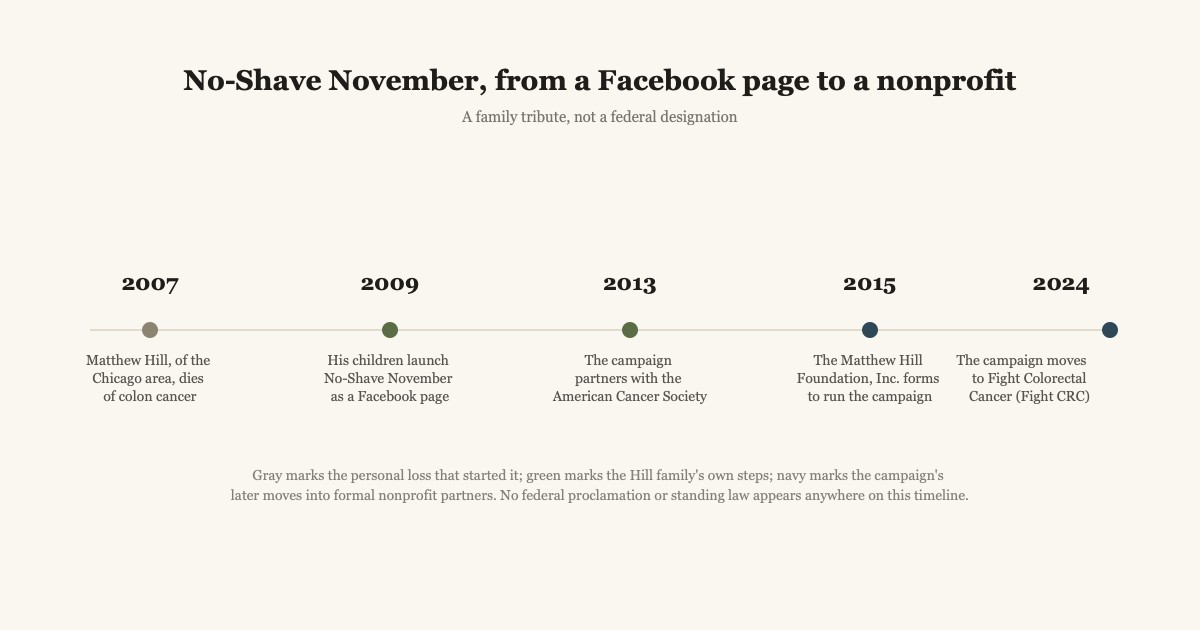
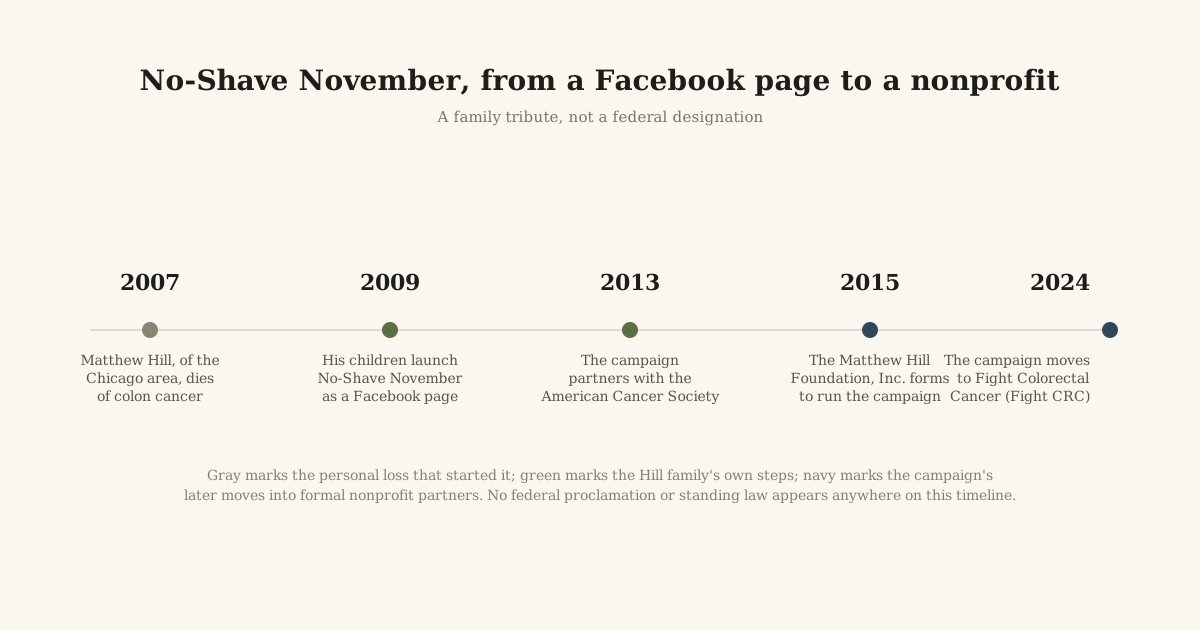
Matthew Hill, of the Chicago area, died of colon cancer in November 2007. Two years later, his eldest daughter, Rebecca Hill, working with a friend, started a Facebook page called No-Shave November, inviting anyone to stop shaving for the month and give the money they would have spent on razors, haircuts, and shaving cream to cancer research instead. The reasoning the family gave for the idea was simple: cancer patients undergoing chemotherapy often lose their hair, so growing hair out for a month was a way to grow it for those who could not.
The first year raised roughly $2,000, a small enough sum that nothing about the campaign's early history reads as inevitable. What followed was closer to how a lot of internet fundraising actually spreads: word of mouth, then local news coverage, then eventually national attention, with the family's youngest members handling logistics like bracelet orders and support emails alongside their older siblings well into the campaign's second decade.
From a Facebook page to a registered nonprofit
The campaign's organizational history since 2009 runs through a few identifiable steps, though not all of them are documented with the same precision as the founding itself. Reporting on the campaign describes a 2013 partnership with the American Cancer Society, which broadened its scope beyond the family's initial supporters into a more general cancer-research fundraising effort. Nonprofit registries separately list the Matthew Hill Foundation, Inc. as formed in 2015 to formalize the campaign as a tax-exempt organization.
The most recent change is also the best documented, because the organization itself states it plainly: in 2024, No-Shave November moved to Fight Colorectal Cancer, a national nonprofit headquartered in Springfield, Missouri. Fight CRC's site frames the current arrangement as continuing the Hill family's work rather than replacing it, and lists Man Up To Cancer and the Prevent Cancer Foundation as the campaign's other current partner charities.
No-Shave November is not Movember
The two campaigns are frequently confused, and the confusion runs in both directions: some assume No-Shave November is simply the American name for Movember, and others assume the reverse. Neither is true. Movember started in 2003 in Melbourne, Australia, when Travis Garone and Luke Slattery encouraged friends to grow mustaches for the month, initially in support of prostate cancer research; it later broadened to cover men's mental health and suicide prevention as well. No-Shave November started six years later and an ocean away, out of one Chicago family's loss.
The rules differ, too. Movember asks participants to start the month clean-shaven and grow a mustache only, nothing else. No-Shave November has no such requirement: the instruction is simply not to shave, full stop, whether that means a beard, a mustache, or, for women who choose to participate, skipping other hair removal. Fight CRC's rules page puts it this way: some people avoid shaving anything, others focus on one area, and the campaign leaves the specifics up to the participant. Two different nonprofits, two different rule sets, and two founding stories that never intersect.
What counts as participating
No-Shave November carries no legal status of any kind. No federal or state offices close for it, and no workplace is required to recognize it. Participation is entirely informal: skip shaving and grooming for the month, and either pledge the money saved directly or simply donate to one of the campaign's partner charities. Fight CRC's fundraising pages let individuals or teams set their own targets, and businesses can register as sponsors.
Because the campaign was reinvented by a family rather than legislated into existence, its shape has shifted more than most observances on this calendar without ever changing its dates. What has stayed constant since 2009 is the core idea: let hair grow as a visible reminder of what cancer patients lose, and redirect a month of grooming money toward research instead.
Where this fits among grassroots observances
No-Shave November belongs to a small group of observances on this calendar that a private individual or family started and that never picked up federal backing at all. National Sons Day has a documented founder for its March 4 date, Jill Nico in 2018, but like this campaign, no federal recognition of any kind; a rival September 28 date for that same observance circulates widely with no traceable origin at all. Red Ribbon Week, by contrast, has been organized every year since 1988 by a single nonprofit, not a federal agency, much like this campaign, though its founding traces to a slain DEA agent rather than a private family's loss. Domestic Violence Awareness Month shows the other path entirely: an advocacy-founded observance that did eventually get a congressional designation, if only for two specific years.