October 17, and a claim nobody can source
National Pasta Day lands on October 17 every year, a fixed date rather than a floating one, which puts it on a Saturday in 2026. Nearly every calendar site describes the day the same way, and most of them repeat some version of the same origin story: that the National Pasta Association designated the date back in 1995. This page went looking for whoever actually made that decision.
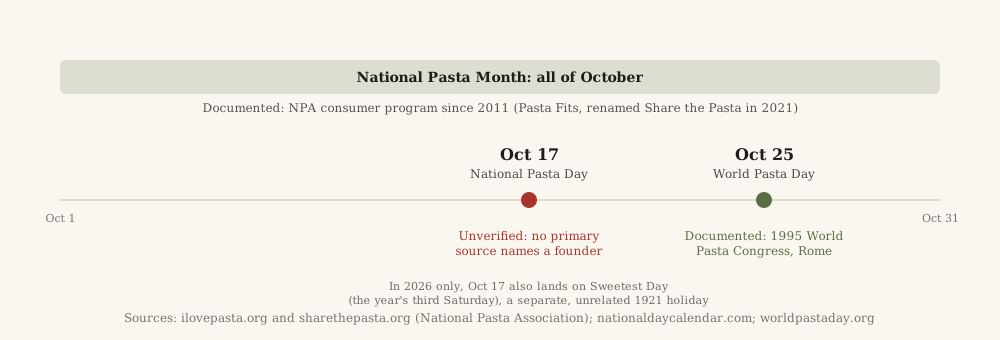
It isn't there. The National Pasta Association's website covers its industry's history in real detail, including the year its trade group formed and the year it changed its name, but nowhere claims credit for October 17 specifically. National Day Calendar, the site most people land on when they search this term, is more direct about the gap than most: its page for the holiday states plainly that it "continues researching the origins of this delicious food holiday." That is an unusual admission from a site that dates and sources most of its thousands of other entries, and it does not square with the confident, specific "1995" story that keeps circulating elsewhere.
What the National Pasta Association actually put its name on
The National Pasta Association itself is not in question, only the day it's often credited for. It traces to 1904, when a group calling itself the National Association of Macaroni and Noodle Manufacturers of America formed, with annual dues of $5, as the U.S. pasta industry grew out of an era that had begun with the country's first commercial pasta factory, opened on the Brooklyn waterfront in 1848 by French immigrant Antoine Zerega. The organization took its current name, National Pasta Association, in 1981.
What the association has actually put its name to, consistently and for years, is a month, not a single day: National Pasta Month, promoted every October through a consumer-facing program the group has run since 2011. That program wasn't always called Share the Pasta, either: the association operated it as Pasta Fits from 2011 until a January 2021 relaunch renamed it Share the Pasta, according to the group's own announcement of the change. A specific October 17 "day," carved out of that month and credited to a 1995 association decision, is the part this page could not turn up in anything the group has published.
The pasta day that is verifiable: October 25
Eight days later on the calendar sits a different pasta observance with an actual paper trail. World Pasta Day traces to the first World Pasta Congress, held in Rome on October 25, 1995, where pasta makers from around the world agreed the food deserved annual worldwide recognition, according to the event's official website. The congress happened in 1995, but the annual celebration itself didn't start immediately afterward: that same website states the day has been marked "every year since 1998," a three-year gap between the founding meeting and the first actual observance that tends to get smoothed over whenever the two years get mentioned together.
National Pasta Day and World Pasta Day get used interchangeably in casual writing, and some retailer promotions run "pasta week" campaigns spanning both without distinguishing them. They are two different observances eight days apart, with two very different origin stories: one that a primary source actually documents, in Rome in 1995, and one that neither the association usually credited nor the internet's most-consulted day-calendar site can confirm.
What the trade group's numbers say Americans actually eat
Whatever the truth about who picked October 17, the National Pasta Association's published figures back up the holiday's underlying claim that pasta is a real American staple. According to a consumer fact sheet the association distributes, the average American eats approximately 20 pounds of pasta a year, a total the group calls the sixth-highest of any single food category measured per person nationally, at an average shelf price around $1.45 per pound. A consumer survey cited in that same document found 73% of respondents ate pasta at least once a week or more. On the supply side, the sheet puts U.S. production at about 4.4 billion pounds of pasta annually, describing that as the second-largest volume of any pasta-producing country.
That fact sheet carries no printed date, but its references to pandemic-era buying shifts, including a cited 80% of consumers eating more pasta since the pandemic began, place its data around 2020-2021. This page could not find a newer release updating those figures, so treat the consumption, production, and price numbers above as a documented baseline from that period rather than a fresh count for the current year.
Why the 1995 story keeps circulating anyway
The 1995 claim likely persists because it reads like a real citation without being one: it names an actual organization, attaches a specific year, and mimics the structure of holidays that were, in fact, registered this way. National Boss's Day, for one, really was registered by a named individual, Patricia Bays Haroski, back in 1958. Once a sentence with that shape appears on one calendar site, later sites tend to copy its structure rather than check it, and nothing published by the trade group, or by National Day Calendar in its admitted uncertainty, ever catches up to correct it. The result is a claim that reads as sourced without ever actually having been sourced.
A calendar quirk that only applies in 2026
National Pasta Day's fixed October 17 date happens to land on something else in 2026 specifically: Sweetest Day, a real and separately documented 1921 Cleveland observance that this site's roundup of October's national days traces to a twelve-member committee of local confectioners. Sweetest Day isn't fixed to a calendar date, though; it floats to the third Saturday of October every year, and running the math for both rules side by side shows the two land on the same day only in 2026 within the next several years. In 2027, Sweetest Day falls a day earlier, on October 16; the two observances won't share a date again through at least 2032. The overlap is a one-year coincidence, not a connection: no source ties the two observances to each other, and treating a shared date as evidence of a shared origin would repeat exactly the kind of unsourced leap this page has tried to avoid making about October 17 itself.