
A month with a founding story that doesn't check out
April is widely called Autism Awareness Month in the United States, and increasingly Autism Acceptance Month as well. Unlike its calendar neighbor, Breast Cancer Awareness Month, which has actual congressional joint resolutions and a first presidential proclamation, Number 6202 from 1990, on the public record, no comparable government document establishing an entire 'Autism Awareness Month' turned up in either of the two primary archives checked for this page.
That gap matters because a specific, detailed founding story circulates anyway: a 1970 'National Autistic Children's Week' that supposedly grew into a full month, formalized by a Reagan proclamation in April 1988. The story is precise enough to sound checked. It has not been.
Where the 1970 and 1988 claims actually come from
Searching for that founding story turns up the same two sentences, worded almost identically, across a long list of applied-behavior-analysis therapy clinics and calendar sites: a 1970 National Autistic Children's Week launched by the Autism Society, evolving into a month, then Reagan's 1988 proclamation making it official. None of those pages cite a document. None link to the Reagan Library, the Federal Register, or the Autism Society's archives. The pattern, sentence for sentence, reads like a claim that has been copied forward from site to site without being checked against a source at each step.
The Reagan Presidential Library's archive of 1988 material does not make this hard to check. It lists dozens of that year's health and awareness proclamations individually, by name: Mental Illness Awareness Week, National Alzheimer's Disease Month, National Adult Immunization Week, National Senior Citizens Day, National Adult Day Care Center Week, all from 1988. An autism proclamation from the same year, if one existed, would sit alongside them in that same archive. It does not appear there.
The American Presidency Project at UC Santa Barbara, a separate and independently compiled index of presidential documents, tells the same story from a different angle. Searching its full catalog for autism-related proclamations returns a consistent run of documents, but every one of them is titled 'World Autism Awareness Day,' not 'Autism Awareness Month,' and the earliest on record in that catalog dates to 2011, under President Obama, more than two decades after the 1988 date the online founding story claims.
What the record actually documents: one day, not one month
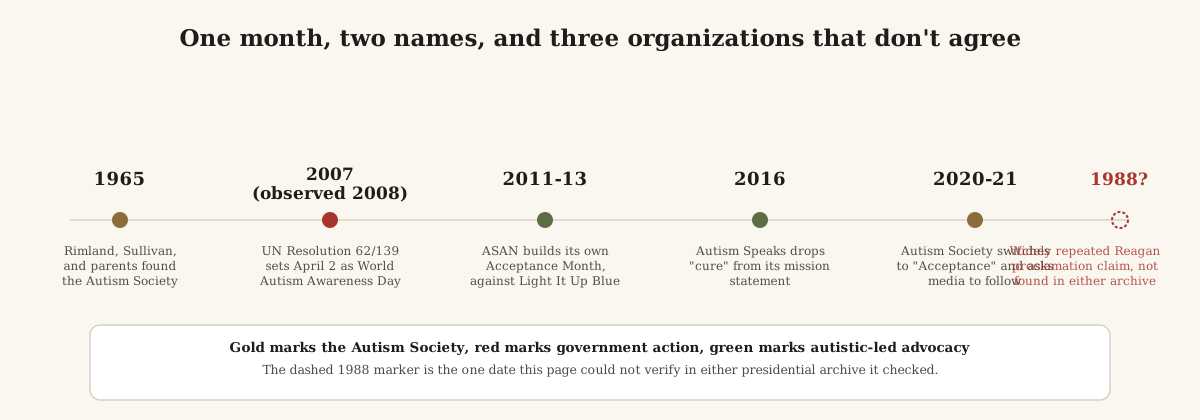
The document that does exist is narrower and more specific than the month-long story: United Nations General Assembly Resolution 62/139, adopted December 18, 2007, after being proposed by Qatar's UN representative, Sheikha Moza bint Nasser, designated April 2 as World Autism Awareness Day, beginning the following year, 2008. It is the UN's first and, to date, only autism-specific observance.
US presidents have kept that specific single-day tradition alive; none has revived a month-long proclamation to go with it. Individual World Autism Awareness Day proclamations turn up on record in three separate administrations, with specific years confirmed under Obama, Trump, and Biden, and each one cites the UN's April 2 date directly, not a congressionally designated month. In 2026, World Autism Awareness Day falls on Thursday, April 2, inside the wider month that carries the less-documented name.
Two names, two organizations that don't fully agree
The Autism Society traces its own history to 1965, when Bernard Rimland, a psychologist and parent of an autistic child, joined with Ruth C. Sullivan and other parents to found what was then called the National Society for Autistic Children. That organization, now the Autism Society, is the one most secondary accounts credit with starting the April observance, even though this page could not verify a specific founding proclamation for it.
The push to rename 'Awareness' as 'Acceptance' did not begin with that organization, though. The Autistic Self Advocacy Network (ASAN), a nonprofit run by and for autistic adults, built its own Autism Acceptance Month campaign starting around 2011 and 2013, explicitly framed as a counterweight to Autism Speaks' better-funded, awareness-focused Light It Up Blue campaign, which the network and other self-advocates criticized for treating autism as a crisis to be solved rather than a form of neurological difference to be accommodated. Autism Speaks itself shifted its own position years later: in 2016, following sustained pressure from autistic self-advocates, the organization removed the word 'cure' from its mission statement entirely, according to reporting at the time from Disability Scoop, a news outlet focused on developmental disability.
The Autism Society made its own switch more recently still, and more formally: materials published by the organization state it first used 'Acceptance' in place of 'Awareness' in 2020 and actively encouraged media outlets to follow suit starting in 2021. Autism Speaks, by contrast, continues to run its April campaign under the name World Autism Month and keeps the Light It Up Blue name active, even as its own materials now describe the campaign using both 'awareness' and 'acceptance' language side by side. The result is that April is called two different things by two organizations that do not fully agree with each other about which name fits, not a settled rename that stuck everywhere at once.
The puzzle piece and the infinity symbol carry the same disagreement
The same awareness-versus-acceptance split shows up in the symbol used for the observance, not just its name. The puzzle-piece ribbon traces to 1963, designed by Gerald Gasson, a parent serving on the board of the UK's National Autistic Society, whose original logo depicted a crying child inside a puzzle piece; board members at the time explained the choice as reflecting autism's status as a 'puzzling condition.' No autistic person had input into that design, because organized autism self-advocacy did not yet exist.
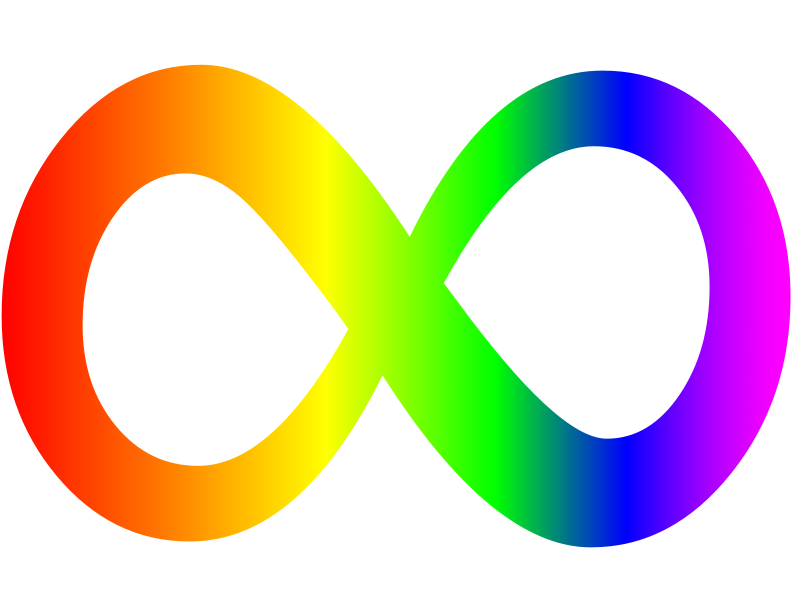
Many autistic adults have since rejected the puzzle piece specifically because it implies a person is an incomplete picture, missing a piece that needs to be found. The alternative preferred by much of the autistic community is a rainbow or gold infinity symbol, used to represent the concept of neurodiversity, the idea that a range of neurological differences, autism among them, is a form of human variation rather than a deficit. This page's header image uses that infinity symbol, not the older puzzle piece, for the same reason the rest of this page separates documented facts from repeated claims: it is the version of the symbol autistic people themselves have organized around, not the one designed for them without their input six decades ago.
What this pattern says about April's crowded calendar of causes
This site has covered a cluster of health and civil-society observances that reach their current shape through the same kind of layered, contested process rather than one clean founding. World Mental Health Day sits inside a six-week stretch alongside two other mental-health dates founded by three entirely separate organizations in three separate years, easy to conflate but never the same observance. Breast Cancer Awareness Month does have the government paper trail this page could not find for autism, and still carries an unresolved dispute over whether a health charity or a drug company founded it first, and in which year. World Teachers' Day shows the same shape again from a different angle: four countries running four separate teacher-honoring traditions under overlapping names, decades apart, none of them derived from the others.
Autism Awareness Month fits that same pattern with one additional wrinkle this page has not found repeated elsewhere on this site: a specific, widely circulated founding date that two separate presidential archives, checked directly, simply do not contain.