.jpg)
What National Mango Day is
National Mango Day is an unofficial food observance held on July 22 in the United States, with a longer-running observance under the same name in India. Neither version carries legal status. No law in either country recognizes the day, and government offices, banks, and postal services run their ordinary schedule regardless of the date. In 2026 it falls on a Wednesday.
In practice, the day works the way National Coffee Day does: a recurring slot on food-brand and retail marketing calendars rather than a civic or religious occasion. The U.S. National Mango Board runs an annual #AlwaysMangoSZN social media campaign around the date, and grocery chains, yogurt brands, and juice makers use it each July to promote mango-flavored products.
The Board also promotes a second, easily confused date: National Mango Month, which falls in June, not July. "Mango has popped up in different applications from soft drinks to hard seltzers to new menu offerings, so National Mango Month comes at the perfect time to highlight where it all starts, fresh whole mango," the Board's executive director, Manuel Michel, said in a June 2021 trade-press release about that separate June observance. The same release cited a 93% rise in U.S. mango consumption per person, from 1.88 pounds in 2005 to 3.63 pounds in 2020.
The 1987 story nobody can source
Search for who started National Mango Day and the same claim turns up, worded almost identically, across a cluster of calendar and lifestyle sites: India's National Horticulture Board designated July 22 in 1987. None of those sites cite a gazette notification, a Board press release, or any other document to back it, and the National Horticulture Board's website has no page describing such a designation. A gazette notification is the normal way an Indian government body records a decision like this, and a direct search turned up none.
There is a well-documented 1987 event tied to mangoes and India, but it is a different thing: the International Mango Festival, a mango exhibition first held that year in Delhi and organized by the Delhi Tourism and Transportation Development Corporation together with the country's horticulture board and export-promotion agency. It has run most years since, usually as a two-day event at a Delhi venue built around mango varieties and cultivation, not a July 22 observance. Even National Today, a major calendar aggregator with an obvious incentive to have a founding story on file, keeps the two apart in its published history for the day: the 1987 entry in its timeline names India's tourism board and the Mango Festival specifically, and stops there, without saying why July 22 got attached to the fruit.
The likeliest reading is that the National Horticulture Board claim has no documented source anywhere, and grew out of a garbled retelling of the Mango Festival's real founding year, not an actual decision to name July 22 as a national day.
A federal marketing order that inherited the date, not one that invented it
The organization most associated with National Mango Day today, the National Mango Board, has a founding that is fully documented and considerably more recent than 1987. The U.S. Department of Agriculture's Agricultural Marketing Service opened a proposed rule and comment period on August 26, 2002, then held an industry referendum on creating a mango research and promotion program; growers and importers approved it with 77% support. The resulting Mango Promotion, Research and Information Order, authorized under the Commodity Promotion, Research and Information Act of 1996, took effect November 3, 2004, and the 18-member Board began operating under it.
That timeline puts the Board's creation seventeen years after the 1987 date already attached to National Mango Day elsewhere. Mango.org marks July 22 every year with recipes and a social media push, but its posts state only that the date exists; they do not claim the Board created it, name a founder, or repeat the National Horticulture Board story at all. The Board built a marketing moment on a date that was already circulating, a pattern National Taco Day follows too, once its own founding gets traced back past the brands that later adopted it.
Nearly half the world's production, from one country
Whatever the truth about who started the day, one country dominates the crop itself. In a written reply to the Lok Sabha on August 1, 2023, India's Agriculture and Farmers Welfare Minister, Narendra Singh Tomar, said India's mango production had risen 12.7% over the prior decade, from more than 184 lakh tonnes (18.4 million tonnes) in 2013-14 to more than 207 lakh tonnes (20.7 million tonnes) in 2022-23, and that India accounted for nearly 44% of world production of mangoes, guavas, and mangosteens combined as of 2020-21. Mango.org, the U.S. industry board's site, calls mango India's national fruit and puts India's share of world mango output even higher, at nearly half.
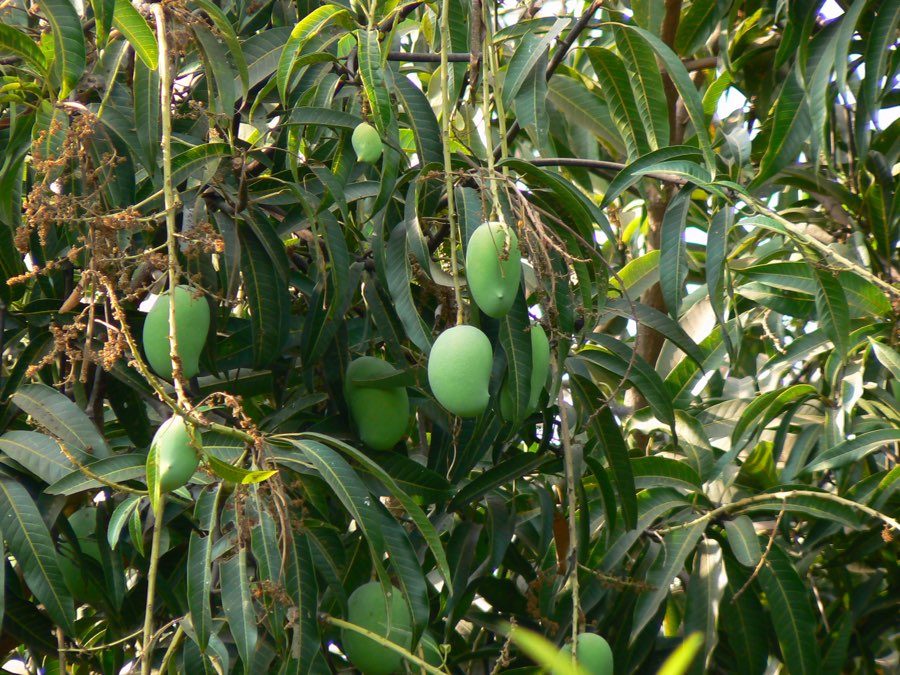
In the United States, the National Mango Board lists six mango varieties commonly sold in supermarkets, including Tommy Atkins, the large red-and-green mango most Americans picture by default, and Kent, a sweeter, less fibrous variety available across two overlapping growing windows that together cover most of the year.
What's actually in a mango
The National Mango Board's nutrition label, sourced to the USDA National Nutrient Database, puts a 3/4-cup serving of mango pieces (124 grams) at 70 calories, 19 grams of carbohydrate, 2 grams of fiber, and 1 gram of protein. The same serving carries 45 milligrams of vitamin C, half of a 2,000-calorie diet's daily value, plus smaller shares of vitamin A (8%), folate (15%), copper (15%), and potassium (4%). On that basis, the Board markets mango as an excellent source of vitamin C and a good source of folate and copper.