
What sign is June 22, really
Every mainstream astrology publisher agrees on the broad strokes: June 22 is Cancer. AstroStyle and Farmers' Almanac both give the sign's range as June 21 to July 22, which puts June 22 on the second day of the sign, not its opening one.
Go looking for exactly where Cancer starts, though, and the sources stop agreeing, sometimes within the same source. Wikipedia's entry on Cancer (astrology) opens by stating that "the Sun transits this area between approximately June 22 and July 23," then two sections later says anyone "born from approximately June 21 to July 22 (depending upon the year)" counts as a Cancer. The opening line makes June 22 the sign's first day; the later section makes it the second. Neither passage cites the other, and nothing in the article flags the mismatch.
That one-day gap looks like sloppy editing, but it's really a symptom of how the tropical zodiac works. Cancer's start isn't a fixed date on the calendar at all. It's pinned to an astronomical event that moves.
Why the start date drifts by about a day
Cancer's opening boundary is set by the June solstice, the moment the Sun reaches its northernmost point and the Northern Hemisphere tilts most directly toward it. In 2026 that moment falls on June 21 at 08:24 UTC, per the U.S. Naval Observatory's published seasons data, which calculates the event to the minute for any year from 1700 to 2100.
The solstice doesn't land on the same calendar date every year because Earth's trip around the Sun takes about 365.2422 days, not a clean 365. Each ordinary year the moment arrives roughly six hours later than the year before, and a leap day resets most of that drift every four years. Across that cycle the solstice moves within a narrow band, generally June 20 to June 22, and which side of midnight it falls on in a given time zone decides whether that year's Cancer opens on the 20th, 21st, or 22nd.
That's the entire explanation for why AstroStyle and Farmers' Almanac say June 21 while Wikipedia's opening paragraph says June 22. Neither is disagreeing about astrology. They're rounding a moving target to different days.
How far the wobble actually reaches
Pop-astrology sites treat the Gemini-Cancer boundary as a wide, mysterious "cusp." YourTango, for one, places the cusp window at June 16 through June 22, implying nearly a week of genuine ambiguity about which sign applies.
The Naval Observatory's actual solstice data doesn't support a window anywhere near that wide. Checked year by year against the agency's published data, the June solstice has landed only on June 20, 21, or 22, never earlier or later, and June 22 is the rare edge of that range: the tables show it hasn't happened since 1975, and it doesn't recur through 2100, the far limit of the agency's current calculator. For anyone born in the past half-century, or anyone who will be born through the end of this century, June 22 sits a full calendar day past where the solstice can plausibly fall, with no real chance the sign boundary crosses it. A month earlier on the calendar, a different sign boundary gets the same scrutiny: this site's May 22 zodiac page checks five years of ephemeris records against the Taurus-Gemini line and finds the real crossing consistently a day or two ahead of schedule.
The birthdays where the tropical sign genuinely can't be read off a calendar are June 20 and June 21, the two dates the solstice actually moves between. A "cusp" defined the way YourTango and similar sites define it, spanning nearly a week, is describing a mood more than a measurable fact.
Settling a genuine June 20 or 21 birth takes more than any general-purpose date range. It takes an ephemeris, a table giving the Sun's exact position for a specific date, time, and location, checked against the birth's own local time zone. A calendar page like this one answers the question correctly for the overwhelming majority of Cancer births, June 22 comfortably among them, and has nothing useful to say about the small slice of people born within a day of the solstice itself, where the hour of birth, not just the date, decides which sign applies.
What the actual constellation is doing on June 22
Zodiac dates and constellation positions are different questions, and Cancer shows the gap better than most signs. Per EarthSky, the Sun doesn't pass in front of the actual constellation Cancer until roughly July 21, staying there until about August 10, a full month after the tropical zodiac says Cancer season opens.
That lag is precession, the slow 25,800-year wobble of Earth's rotational axis, at work. It's also why the Tropic of Cancer, the latitude line where the solstice Sun sits directly overhead, still carries Cancer's name from when Greco-Roman astronomers drew it more than two thousand years ago. Per Wikipedia's entry on the line, the Sun sat in front of the constellation Cancer at the June solstice when the name was fixed; today, at that same solstice, the Sun sits in front of Taurus. The tropical zodiac ignores this drift by design, resetting to the solstices and equinoxes every year regardless of which stars sit behind the Sun, while the constellation itself has simply moved on without it.
A different calendar entirely: Vedic sidereal astrology
Vedic astrology, practiced widely across South Asia, uses a sidereal zodiac tied to the fixed stars rather than the solstice, and it places the Sun's entry into Karka (Cancer) about a month after the Western tropical start. The 2026 transit, called Karka Sankranti, falls on July 16, per the Hindu festival calendar site Ganesha Speaks, and marks the start of Dakshinayana, the period Hindu tradition associates with the Sun's southward journey.
The gap between the two systems is less a disagreement than two reference points drifting apart over centuries. Tropical astrology resets to the solstice every year; sidereal astrology tracks the actual backdrop of stars; the difference between them, called the ayanamsha, widens by roughly a degree every 72 years. A person born June 22 is a tropical Cancer on every Western horoscope chart and, on the Vedic calendar, still a sidereal Gemini, since that transition doesn't arrive until the sidereal Sun reaches Karka in mid-July. A much wider version of that same tropical-versus-sidereal gap turns up in mid-autumn: this site's October 14 zodiac page finds a date that's solidly tropical Libra while the Vedic sidereal calendar and the actual constellation the Sun sits in front of both still read Virgo.
What doesn't move: symbol, planet, and birthstone
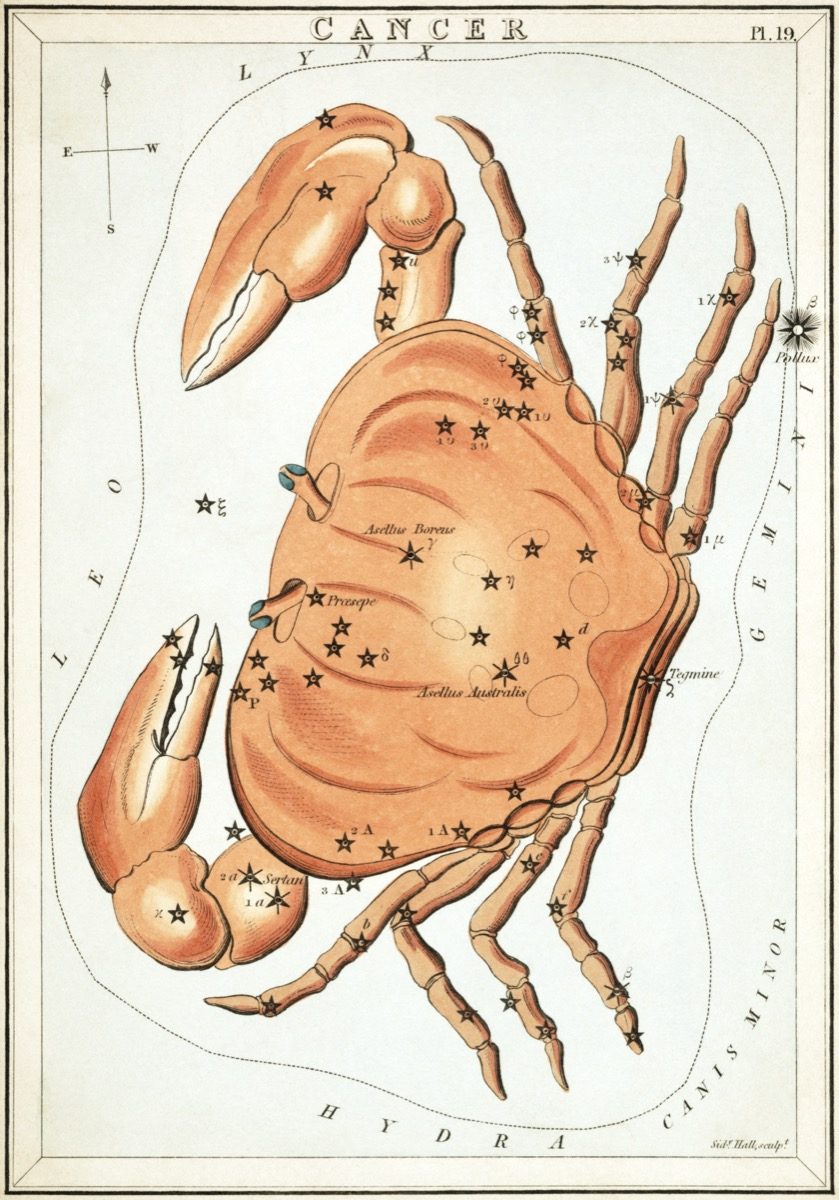
Whichever calendar sets the boundary, Cancer's traditional attributes stay fixed across every tropical source. It's a cardinal Water sign, ruled by the Moon, and represented by the crab, tracing to a Greek myth in which a crab that harassed Heracles during his fight with the Hydra was crushed underfoot and placed among the stars by Hera afterward.
One thing the tropical system doesn't supply is an official birthstone. This site's June birthstone page documents the Jewelers of America chart: pearl and moonstone from the original 1912 list, with alexandrite added forty years later. There's no comparable trade-group chart assigning stones to zodiac signs, and readers a day or two over on the Gemini side run into a separate mismatch: this site's Gemini birthstone page traces the "pearl and alexandrite" claim some retailers make for Gemini back to June's own monthly list, since the older zodiac birthstone table most of those retailers actually draw from names agate for Gemini instead.