
One birthstone, never touched since 1912
Diamond is the only birthstone the Jewelers of America trade chart assigns to April, and it has held that spot since the chart existed. The group, then called the American National Retail Jewelers Association, standardized a twelve-month birthstone list in 1912. According to DayAlmanac's month-by-month breakdown of that chart, it has been revised three separate times since: a 1952 update added alexandrite to June, citrine to November, tourmaline to October, and zircon to December; tanzanite joined December's list again in 2002; spinel joined August in 2016. None of those three rounds touched April. Along with January, February, March, May, July, and September, April has kept the exact stone it started with.
That is the modern list. A separate traditional list, which the International Gem Society traces to Poland between the 16th and 18th centuries and which predates the 1912 trade convention entirely, also lands on diamond for April. That agreement is not universal across the calendar: October is the clearest mismatch, since the modern list names tourmaline while the traditional list names opal, and a shopper who trusts only one source can end up buying the wrong stone for a month that never settled on one answer. April's birth flowers, daisy and sweet pea, never got the modern list's kind of single-body standardization either; DayAlmanac's April birth flower page covers why that pairing stayed split between competing 19th-century sources instead of converging the way birthstones did.
Where the stone's history actually starts
Diamond's use as jewelry predates its status as a birthstone by roughly two thousand years. GIA traces the trade to India, where diamonds were gathered from rivers and streams and traded as early as the fourth century BCE, prized by royalty and the wealthy. Caravans later carried Indian diamonds to medieval markets in Venice, and by the 1400s they had become fashionable among Europe's elite. The first diamond engagement ring on record dates to 1477, when Archduke Maximilian of Austria gave one to his betrothed, Mary of Burgundy.
India's Golconda mining region produced the stone now known as the Hope Diamond, a 45.52-carat blue diamond that recent evidence traces to that source before its sale to King Louis XIV of France in 1668, when it went by a different name, the French Blue. Those Indian deposits carried the world's diamond supply for centuries, until they began running low in the early 1700s and the trade had to look elsewhere.
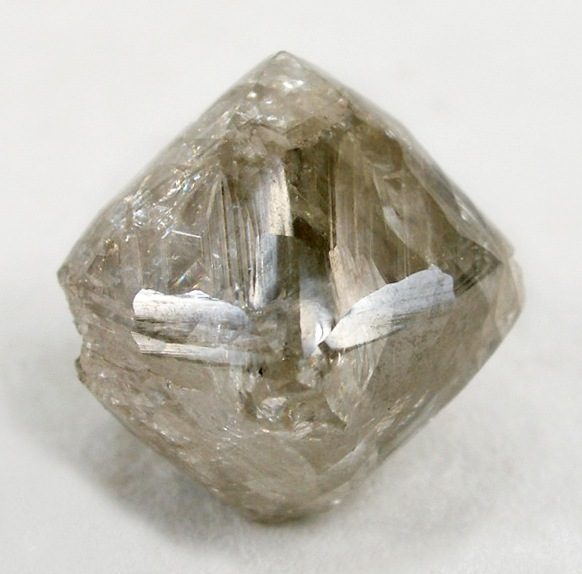
Three moves in two hundred years, India to Brazil to South Africa
Brazil picked up where India left off. Gold miners sifting gravel along the banks of the Jequitinhonha River, in what is now Minas Gerais, started turning up diamonds in the early 1700s, and Brazil dominated the world market for more than a century and a half. The next shift came in the late 1860s, when diamonds turned up near Kimberley, South Africa, an event GIA marks as the start of the modern diamond market. Entrepreneur Cecil Rhodes founded De Beers Consolidated Mines in 1888, and within twelve years the company controlled an estimated 90 percent of the world's rough diamond production.
South Africa's Premier mine produced the largest diamond ever recovered, a 3,106-carat rough stone found in 1905. Cut down, its largest piece became the pear-shaped, 530-carat Cullinan I, also called the Great Star of Africa, now set in Britain's Royal Sceptre with Cross alongside the rest of the Crown Jewels in the Tower of London. The Cullinan's record has held for well over a century, surviving even Botswana's Karowe mine turning up a 2,492-carat stone in August 2024, the second-largest gem-quality rough diamond ever found and, according to Lucara Diamond Corp, the biggest recovered in 120 years.
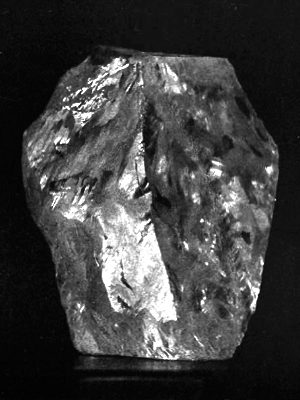

Hardest gem on the chart, with one hidden weak point
The word diamond comes from the Greek adamas, meaning invincible or unbreakable, and on one measure that reputation holds up: diamond sits at 10, the top of the Mohs hardness scale that mineralogist Friedrich Mohs introduced in 1822. Only another diamond can scratch a diamond.
Hardness is not the same thing as toughness, and GIA is direct about the gap: diamond is the hardest gemstone but not necessarily the toughest one, and a hard blow can still cleave or fracture it despite its resistance to scratching. The weak point runs along cleavage planes, directions where the stone's carbon atoms are bonded less tightly than everywhere else; strike one at the wrong angle and a diamond that shrugged off a steel blade can split cleanly in two. GIA's own care guidance is more cautious on cleaning than the hardness rating alone would suggest: it advises against ultrasonic and steam cleaners at home, not because the diamond itself would be damaged, but because the vibration can loosen a stone in its setting, and it recommends a lint-free cloth, mild detergent, or a professional jeweler's cleaning instead, doubly so for a heavily included or treated stone.
The company that built the modern diamond trade just quit lab-grown
De Beers, the company Cecil Rhodes founded in 1888, spent the last several years running a lab-grown diamond jewelry brand, Lightbox, launched in 2018 at a transparent $800 per carat. In May 2025, De Beers announced it would close the business. Wholesale prices for lab-grown diamonds in the jewelry sector had fallen 90 percent since Lightbox launched, the company said, tracking closer to a cost-plus manufacturing model than to anything priced like a natural stone. CEO Al Cook tied the decision to natural diamonds specifically, citing cheap lab-grown supply from China and US supermarkets pushing prices lower still.
GIA changed how it grades the two kinds of stone within the same year. Since October 1, 2025, GIA has stopped applying its natural-diamond 4Cs system, the same grading standard it built in 1953, to lab-grown diamonds. Factory-made stones now receive a 'Premium' or 'Standard' rating instead, a label GIA president Pritesh Patel tied to most lab-grown diamonds clustering tightly in one narrow band of color and clarity, too narrow for the finer natural-diamond scale to mean much. Anyone shopping for diamond jewelry for an April birthday in 2026 is comparing across two separate grading systems, not just two price tags. Diamond has one other job on the calendar, unrelated to birth months: it is also the traditional 60th and 75th wedding-anniversary gem, alongside the earlier-year stones DayAlmanac's anniversary-gift breakdown covers.